
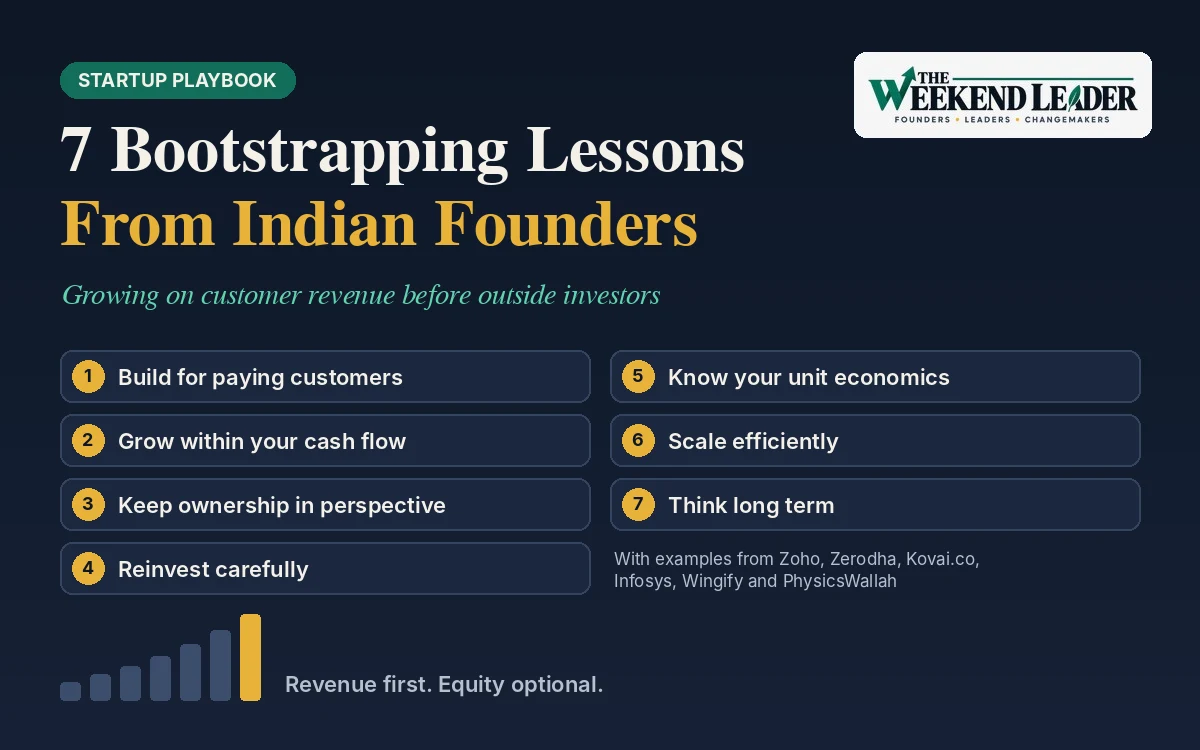
The most useful bootstrapping lessons from Indian founders are simple to say and hard to practise: sell something people will pay for, grow only as fast as your cash allows, protect your ownership, reinvest with care, know your unit economics, choose a model that scales, and think long term. This article shows each lesson through a real company — Zoho, Zerodha, Kovai.co, Infosys, Wingify and PhysicsWallah.
Many first-time founders assume a startup begins with a pitch deck and an investor cheque. It doesn’t have to. Bootstrapping a business in India — using savings, customer revenue and careful reinvestment — is how plenty of companies started, and some never took outside equity at all.
One honest caveat up front. Only three of the six companies here, Zoho, Zerodha and Kovai.co, have grown without outside equity investors as far as public records show. Infosys, Wingify and PhysicsWallah bootstrapped for years and later raised or sold equity. Their early years still hold lessons, and we label each one clearly. Bootstrapping is not just about spending less; it shapes how you choose customers, hire, price and take risks.
What is startup bootstrapping?
Bootstrapping means building a business with the founders’ own money and the revenue the business earns, instead of selling shares to outside investors. A bootstrapped company typically starts with personal savings or small contributions from founders, uses customer payments to cover running costs, reinvests profits into growth, keeps spending tight and retains more ownership than a venture-funded company.
Bootstrapped does not always mean debt-free. Some self-funded Indian startups use bank loans, working-capital lines or customer advances. The key difference is that they do not give away equity to investors.
The advantages are real: founders keep more ownership and control, the business is forced to focus on paying customers, and spending tends to be more disciplined. So are the drawbacks. There is less cash for expansion, growth can be slow in capital-heavy sectors, founders carry personal financial risk, and competing with a well-funded rival can be hard.
7 bootstrapping lessons from Indian founders
1. Build something customers are willing to pay for — PhysicsWallah
Funding status: bootstrapped until its first institutional round in 2022.
Alakh Pandey started PhysicsWallah in 2016 as a free YouTube channel for students preparing for JEE and NEET. By the time the company was set up in 2020, it already had something most new businesses lack: an audience that trusted the teaching. It then sold courses at very low prices — as little as $4, according to TechCrunch — compared with the far higher fees charged by large edtech rivals.
That mix of proven value and affordable pricing brought in paying students before any institutional investor was involved. Its first institutional round, a $100 million Series A from WestBridge and GSV Ventures, came only in June 2022. At the time, Pandey said the company had been “profitable since inception with positive cash flows” — a company claim rather than an audited figure. PhysicsWallah later listed on the stock exchanges in November 2025.
Takeaway: Revenue is the cheapest capital a startup will ever get. Prove your value — even for free at first — then charge a price your customers can actually pay.
2. Grow at a pace your cash flow can support — Infosys
Funding status: founder-funded for its first 12 years; raised public equity through an IPO in 1993.
Infosys was incorporated in Pune on 2 July 1981 by N. R. Narayana Murthy and six co-founders, with initial capital that Wikipedia puts at about US$250. It moved to Bangalore in 1983 and grew for more than a decade on client work before going public.
Its IPO came in February 1993 at ₹95 a share. Even then, the issue was initially undersubscribed, and Morgan Stanley took a 13% stake to stabilise it. That detail matters: a company with years of operating history still found raising outside money harder than expected. By building steadily on client revenue first, Infosys was not dependent on that IPO to survive.
Infosys is not an example of a company that never raised money. It is an example of patient, revenue-funded growth before outside capital — and of the fact that public markets and investors don’t always arrive on a founder’s timetable.
Takeaway: Plan growth around money you have or reliably expect to collect, not money you hope to raise.
3. Keep ownership and control in perspective — Wingify
Funding status: no outside funding from 2010 until a private equity firm bought a majority stake in January 2025.
Paras Chopra started Wingify in 2010. Its main product, VWO, helps websites run A/B tests to improve conversion rates. According to TechCrunch, the company raised no external funding for about 15 years, grew to roughly $50 million in annualised revenue and served more than 6,000 clients.
Because he hadn’t sold equity along the way, Chopra still owned 71% of the company when Everstone Capital bought a majority stake for about $200 million in January 2025. He kept a minority stake and a board seat, and co-founder Sparsh Gupta took over leadership.
The lesson cuts both ways. Bootstrapping gave Chopra choices — when to sell, to whom and on what terms. But Wingify’s own next chapter involved outside capital, which is a reminder that equity investment is a tool, not a failure.
Takeaway: Every share you sell early is expensive. Know why you’re selling it, and what you get beyond money.
4. Reinvest in the business carefully — Kovai.co
Funding status: bootstrapped; no outside investors reported.
Saravana Kumar, a Microsoft BizTalk consultant from Coimbatore, began building a monitoring tool as a side project in 2010. It became BizTalk360, which, according to StartupTalky, got its first customer within two months. Kovai.co, the company behind it, was set up in 2011.
Instead of using early profits to chase growth everywhere at once, Kovai.co reinvested in new products close to its expertise. It launched Document360, a knowledge-base platform, in 2019, and added Turbo360 for Azure cloud management. In December 2025, the company said Document360 had crossed $10 million in annual recurring revenue — its second product to reach that level without venture capital — and announced a planned ₹220 crore investment in its Coimbatore development centre.
Kovai.co is also a good reminder that bootstrapped software companies can be built from Tier-2 cities, not just Bengaluru.
Takeaway: Reinvest where you already have an edge, and fund new bets from profits the existing business has already earned.
5. Focus on profitability and unit economics — Zerodha
Funding status: self-funded; owned by the Kamath family; no venture capital.
Nithin and Nikhil Kamath launched Zerodha in August 2010 with about ₹2 crore from Nithin’s savings and a contribution from a friend, according to Wikipedia. Nithin has said the company began as a partnership partly because exchange deposit requirements were lower for partnerships, and that it started small and stayed “extremely frugal.”
Its pricing is a lesson in unit economics: a flat fee of up to ₹20 per trade, with equity delivery free. That only works when the cost of serving each extra customer is low. Once the model and the technology were in place, the numbers became significant. For FY24, Wikipedia reports revenue of ₹9,372 crore and net income of ₹5,496 crore.
One distinction worth knowing: profit and cash are different. A business can show a profit on paper and still run short of cash if customers pay late or money is tied up in inventory. Bootstrapped founders need to track both.
Takeaway: Know what each customer costs you to win and serve, and what they bring in, before you scale.
6. Build a business model that can scale efficiently — Zoho
Funding status: never raised external capital, according to its CEO.
Software is one of the few businesses where the cost of serving another customer can be very low. Zoho shows what that means over decades. In September 2023, it reached 100 million users across 55 business applications, and Sridhar Vembu described it as “a bootstrapped company that has never raised external capital.” It had 1 million users in 2008 and 50 million in 2018.
Zoho’s suite of related products lets the same customers buy more over time, from CRM to email to accounting. That is efficient growth: each product shares infrastructure, sales channels and customer trust with the others.
Scalability varies by industry, though. A restaurant, a factory or a logistics company adds real costs with every new location or customer. Founders in those sectors should expect slower bootstrapped growth.
Takeaway: Ask early whether your costs rise in step with revenue. If they do, plan for steadier growth — or for outside capital.
7. Make long-term decisions instead of chasing every trend — Zoho
Zoho began in 1996 as Advent Network Management, founded by Sridhar Vembu, Tony Thomas and others. In 1999, Vembu turned down a venture capital offer because it required an exit — liquidity or an IPO — within eight years, according to YourStory.
Then the dot-com bust hit. Business largely dried up because much of its revenue came from the telecom sector. Rather than shut down, the company built new products: ManageEngine in 2002 and Zoho’s online applications from 2005, including Zoho CRM. It even bought the Zoho.com domain for $5,000 in 2002. The company was renamed Zoho Corporation in 2009.
Without investors pressing for an exit date, Zoho could take a decade-long view of its products. That patience is hard to copy, but the principle applies to any founder: decide what you want the business to be in ten years, and say no to things that don’t serve that.
Takeaway: Focus beats fashion. Choose a few things you can do well for a long time.
Summary: the seven lessons at a glance
| Lesson | Company | Founder(s) | Funding record |
|---|---|---|---|
| 1. Build for paying customers | PhysicsWallah | Alakh Pandey, Prateek Maheshwari | Bootstrapped until 2022 Series A; listed 2025 |
| 2. Grow within cash flow | Infosys | N. R. Narayana Murthy and six co-founders | Founder-funded until 1993 IPO |
| 3. Keep ownership in perspective | Wingify | Paras Chopra (co-founder Sparsh Gupta) | No outside funding until 2025 majority sale |
| 4. Reinvest carefully | Kovai.co | Saravana Kumar | Bootstrapped |
| 5. Know your unit economics | Zerodha | Nithin and Nikhil Kamath | Self-funded; no venture capital |
| 6. Scale efficiently | Zoho | Sridhar Vembu, Tony Thomas and others | Never raised external capital |
| 7. Think long term | Zoho | Sridhar Vembu, Tony Thomas and others | Never raised external capital |
Bootstrapping vs venture capital
Neither route is better for every business. Bootstrapping tends to suit companies that can earn revenue early — software, services, consulting and many consumer brands. Venture capital makes more sense for capital-heavy businesses, or for markets where being first and biggest really matters. Many founders, like first-generation entrepreneurs in India, start with bootstrapping simply because outside capital isn’t available yet.
| Bootstrapping | Venture capital | |
|---|---|---|
| Source of capital | Founder savings, customer revenue, sometimes loans | Investors buy equity |
| Ownership | Founders keep most or all of it | Diluted with each round |
| Growth expectations | Set by the founders and cash flow | Fast growth, usually with an expected exit |
| Decision-making | Founders decide | Shared with investors and the board |
| Financial pressure | Must earn enough to survive | Must grow fast enough to raise the next round |
| Best suited to | Businesses that can earn revenue early | Capital-heavy or winner-takes-most markets |
How to bootstrap a startup: practical tips for Indian entrepreneurs
- Validate demand first. Take pre-orders, run a pilot or sell a simple version before spending heavily.
- Start narrow. One product, one customer type, one city if needed.
- Get paying customers early, even if the first price is modest.
- Track cash flow every week, including money customers owe you. In B2B, 60- or 90-day payment terms can strain a small business.
- Separate personal and business finances with a dedicated bank account.
- Keep fixed costs low — rent, salaries and subscriptions you pay whether or not sales come in.
- Hire for real need, when revenue can support the role.
- Reinvest in what you can measure, such as product quality or a sales channel that works.
- Look after repeat customers; they cost less than new ones.
- Get professional advice on GST, income tax, compliance and contracts.
Common bootstrapping mistakes to avoid
The most common mistake is treating low spending as good financial management. Cutting the wrong costs — product quality, a key hire — can hurt more than it saves. Underpricing is close behind: if your price doesn’t cover costs and leave a margin, growth only deepens the hole.
Watch out, too, for ignoring working capital, expanding before demand is proven, depending on a single large customer, and mixing household and business money. Finally, don’t treat avoiding investors as a point of pride. If your market really needs speed or heavy investment, outside capital may be the sensible choice. A monthly review of cash, margins and customer concentration will catch most of these problems early.
Frequently asked questions
What are the most important bootstrapping lessons for startups?
Sell something customers will pay for, grow within your cash flow, protect ownership, reinvest carefully, understand your unit economics, choose a model that can scale efficiently and make long-term decisions.
What does bootstrapping mean in entrepreneurship?
It means funding a business with the founders’ own money and the revenue it earns, without selling equity to outside investors. Some bootstrapped companies still use loans.
Can a startup succeed without raising funding?
Yes. Zoho says it has never raised external capital and reached 100 million users in 2023. Zerodha is self-funded and family-owned. Success still depends on the market, the model and execution.
What are some Indian startups known for bootstrapped growth?
Zoho, Zerodha and Kovai.co have grown without outside equity investors. Wingify, PhysicsWallah and Infosys bootstrapped for years before raising or selling equity.
Is bootstrapping better than venture capital?
Not universally. Bootstrapping suits businesses that can earn revenue early. Venture capital suits capital-heavy businesses and markets where speed and scale decide the winner.
How can founders finance a startup without investors?
Through personal savings, early customer revenue, advance payments or pre-orders, service work that funds product development, and loans or government schemes where appropriate.
What are the biggest challenges of bootstrapping a business?
Limited cash for growth, personal financial risk, slower expansion in capital-heavy sectors and difficulty competing with well-funded rivals.
Conclusion
The seven lessons are straightforward on paper: build for paying customers, grow within your cash flow, value your ownership, reinvest with care, know your numbers, choose a model that scales and think in decades. Zoho, Zerodha and Kovai.co show they can carry a company a long way without outside equity. Infosys, Wingify and PhysicsWallah show they matter even if you raise money later.
Bootstrapping is a financing choice, not a guarantee of success. Before you decide, validate your idea, understand your costs and pick a business model that fits both your money and your ambitions.
Sources
- Zoho reaches 100 million users with no external funding (Sept 2023) — OfficeChai
- How Zoho came back after the dot-com bust — YourStory
- Zerodha — Wikipedia
- Nithin Kamath on bootstrapping Zerodha — YourStory
- Kovai.co’s Document360 crosses $10M ARR — CXOToday; Kovai.co story — StartupTalky
- Everstone acquires bootstrapped Wingify for $200M — TechCrunch
- PhysicsWallah’s $100M Series A — TechCrunch; Physics Wallah — Wikipedia
- Infosys — Wikipedia
Last updated: October 2026. Company figures are given with the year of the source and may have changed. This article is for general information and is not financial advice.