
Founder profiles usually begin at the funding round or the IPO. The years before — the unpaid loan, the product nobody wanted, the experiment quietly switched off — rarely make the headline. Yet those are the parts a first-time founder can actually learn from.
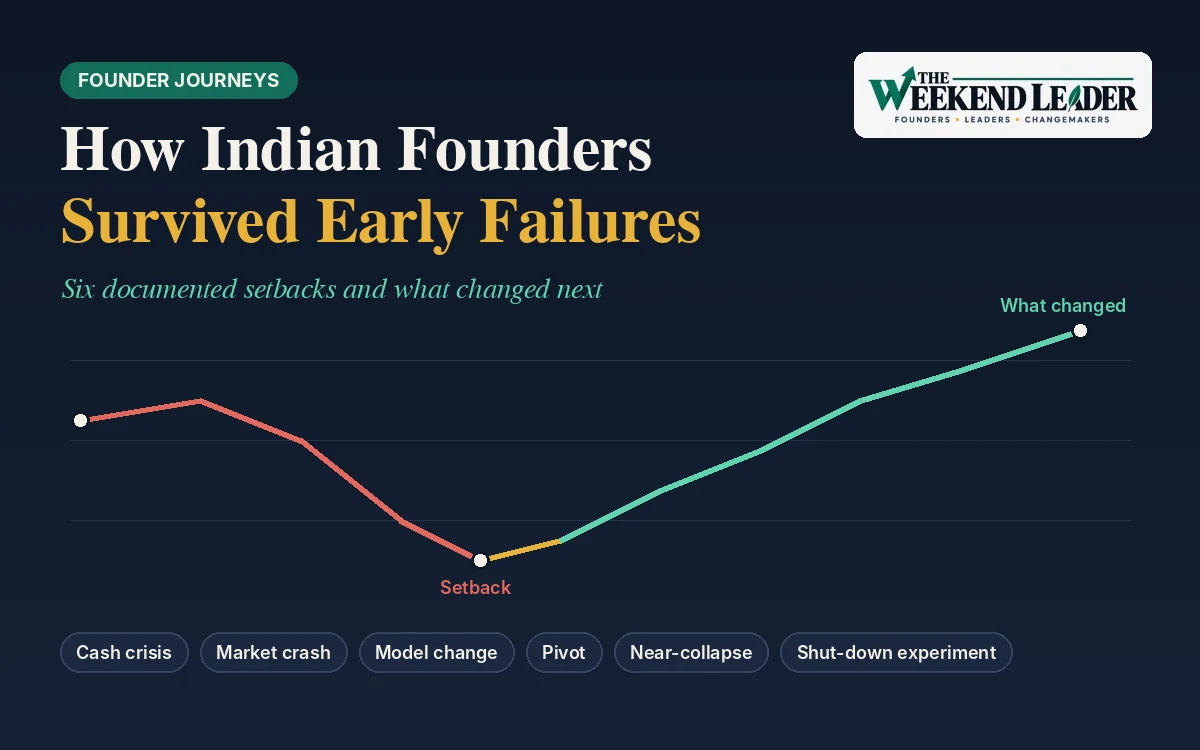
This article collects documented entrepreneur failure stories from India: Vijay Shekhar Sharma’s cash crisis at One97 before Paytm, Zoho’s near-wipeout in the dot-com bust, Ritesh Agarwal’s realisation that Oravel Stays wasn’t enough, Ola’s start as a tour operator, Snapdeal’s brush with collapse in 2017 and Zomato’s two shut-down grocery experiments.
One caveat before we start. Not every failure leads to a comeback, and these founders are not proof that persistence always pays. They are useful because their setbacks are well documented and their responses were specific — which means you can learn from their decisions, not just their outcomes.
Quick answer
Indian founders who recovered from early setbacks usually did three things: they identified the real cause (a cash-flow gap, a weak model, a changed market), they changed something specific in response, and they protected enough cash to try again. The lesson is not “never give up” but “diagnose honestly, then adapt or stop.”
What is an entrepreneur failure story? In this article, it means a documented setback in a founder’s journey — a venture that didn’t work, a business model that fell short, a crisis at a company that survived, or an experiment that was shut down — and what the founder did next.
Key takeaways
- “Failure” covers very different events; name yours accurately before deciding what to do.
- Cash flow problems appear in almost every story, whatever the company’s size.
- Several of these founders changed the business model, not just the effort level.
- Closing an experiment early, as Zomato did with grocery, is a decision, not a defeat.
- Recovery depends on finances, personal circumstances and the market, not willpower alone.
Why a founder’s first failure matters
Early setbacks usually happen for ordinary reasons. Customers like an idea but won’t pay for it. Costs arrive monthly while revenue arrives late. A larger competitor cuts prices. A market the business depends on shrinks overnight.
First-time founders tend to underestimate these problems because a business plan rarely includes them. A failed launch exposes what the plan missed: who actually buys, how much it costs to reach them, and how long cash lasts when sales are slow.
The hardest skill is telling persistence apart from refusing to change. Persistence means continuing to work on a problem customers really have. Refusing to change means repeating an approach that the numbers — sales, margins, repeat purchases — keep rejecting. Customer feedback and financial discipline are how you tell the two apart.
Indian entrepreneur failure stories that offer valuable lessons
Vijay Shekhar Sharma — a cash crisis in One97’s early years
The situation: Vijay Shekhar Sharma started One97 Communications around 2000, after selling his first company, XS Corps, which built content management software. According to his account in Fortune India, his co-founders left after 9/11, and he did not raise outside money for about seven years.
What went wrong: He borrowed from people to fund the business, but cash flow was poorly managed and the loans piled up. He took an ₹8 lakh loan from a family friend at 24% interest and could pay the interest but not the principal. “The cash flow became so negative that having even two cups of tea was a luxury,” he told Fortune India.
How the founder responded: Sharma said he did “odd jobs to make ends meet and repay the loan,” such as setting up email accounts and giving lectures. He also accepted a deal in which a businessman provided ₹8 lakh and office space in exchange for 40% of One97.
What changed: One97 survived, and in 2011–12 its board gave him ₹5 crore for six months to test the idea that became Paytm.
The lesson: Debt taken without a plan to repay it can turn a business problem into a personal crisis. Survival sometimes means giving up equity or taking side work — trade-offs that are better made early than in desperation.
Practical takeaway: Before borrowing, write down the monthly repayment and the exact revenue that will cover it.
Sridhar Vembu — when the dot-com bust wiped out Zoho’s main market
The situation: Zoho began in 1996 as Advent Network Management, founded by Sridhar Vembu, Tony Thomas and others. According to YourStory, it was on track for about $10 million in annual revenue by 2000, selling network-management software largely to telecom companies.
What went wrong: The 2001 dot-com bust hit the telecom sector hard, and business “pretty much dried up.” The setback was external — but the company’s dependence on one sector made it far worse.
How the founder responded: Rather than wait for telecom to recover, the company built new products for other customers: ManageEngine, an IT-management suite, in 2002, and online business applications from 2005, starting with Zoho CRM. It bought the Zoho.com domain for $5,000 in 2002.
What changed: The business moved from one industry to many, and towards subscription software. It was renamed Zoho Corporation in 2009 and has grown without outside investors.
The lesson: Customer concentration is a hidden risk. A healthy-looking business can be fragile if one sector or one client brings in most of its revenue.
Practical takeaway: Check what share of revenue your largest customer or sector brings in. If it is more than half, start building a second source now.
Ritesh Agarwal — when Oravel Stays wasn’t enough
The situation: In 2012, a teenage Ritesh Agarwal from Odisha started Oravel Stays, a platform for discovering budget accommodation. He travelled across India and stayed in many low-cost guest houses to understand the market.
What went wrong: Oravel made hotel discovery easier, but Agarwal told Social Samosa he “soon realized that’s not going to be enough.” The real problem was on the supply side: many unbranded hotels didn’t meet basic standards, so listing them online didn’t give guests a reliable stay.
How the founder responded: Instead of adding more listings, he changed the model — aiming to “consolidate and upgrade the fragmented segment” so the guest experience would be consistent.
What changed: OYO launched in 2013 around predictable, affordable stays. This is a story about changing the model, not proof that every later decision worked.
The lesson: Sometimes the product works but solves the wrong part of the problem. First-hand time with customers — here, nights in budget hotels — shows where the real pain is.
Practical takeaway: Spend a week using your own product as a customer would, and list every point where the experience breaks.
Bhavish Aggarwal and Ankit Bhati — from Ola Trips to ride-hailing
The situation: Ola began in 2010 as Ola Trips, a Mumbai-based tour and travel operator started by IIT-Bombay graduates Bhavish Aggarwal and Ankit Bhati. Aggarwal sold trips in the field while Bhati built the website, according to YourStory.
What went wrong: This was less a failure than a wrong first focus. While planning a weekend trip, the founders struggled to book a cab — and realised that everyday ride booking was a far bigger market than holiday packages.
How the founders responded: They shifted Ola Trips into a cab-booking service, and later moved the company to Bengaluru after raising angel funding. Aggarwal has called the 2011–2014 period a “romantic struggle.”
What changed: The company’s customer, frequency of use and revenue model all changed — from occasional trips to daily rides.
The lesson: Your own frustration as a customer can point to a better business than the one you started. Watch for problems people face weekly, not yearly.
Practical takeaway: Note every complaint customers make about things next to your product. One may be a bigger opportunity.
Kunal Bahl and Rohit Bansal — Snapdeal’s near-collapse in 2017
The situation: By 2016, Snapdeal was one of India’s largest e-commerce companies, backed by SoftBank and competing with Flipkart and Amazon on discounts and scale.
What went wrong: Losses for 2016–17 reached about ₹6,000 crore, according to filings reported by BloombergQuint. In an email to staff, Kunal Bahl admitted the company “started making mistakes” by scaling before finding the right economics and market fit, Business Today reported. Merger talks with Flipkart were called off in July 2017.
How the founders responded: Bahl and Bansal took a 100% salary cut. Under a plan Bahl called Snapdeal 2.0, the company cut costs sharply, sold its Freecharge wallet to Axis Bank and its Vulcan Express logistics arm to Future Group, and reduced its workforce heavily. “We were going to fall off a cliff if a call was not taken immediately,” Bahl wrote in October 2017.
What changed: Snapdeal became a much smaller marketplace focused on value shoppers, many in smaller cities. Losses narrowed by nearly ₹4,000 crore by March 2018, although analysts questioned how profitable it really was.
The lesson: Growth bought with discounts can hide a broken model. Recovery came at a real human cost — many employees lost their jobs.
Practical takeaway: Track contribution margin per order from day one. If it is negative, growth makes the problem bigger.
Deepinder Goyal and Zomato — two grocery experiments that were shut down
The situation: Zomato, co-founded by Deepinder Goyal, is a food-delivery company. In April 2020, during the pandemic, it tried grocery delivery; that trial ended within months, according to MediaNama.
What went wrong: A second grocery pilot launched in July 2021 using local stores. In September 2021, Zomato told partners it would stop, citing gaps in order fulfilment, poor customer experience and competition from rivals offering express delivery.
How the company responded: Zomato said it had “decided to shut down our grocery pilot.” It had already bought a 9.3% stake in Grofers in August 2021, saying Grofers had found strong product-market fit in quick grocery delivery.
What changed: Instead of building grocery from scratch a third time, Zomato backed a business that was already working in the category.
The lesson: A pilot is only useful if you are willing to end it. Small, time-bound experiments limit losses and leave room for a different route.
Practical takeaway: Before launching a pilot, write down the result that would make you stop it, and the date you will decide.
Founder comparison: setbacks, responses and lessons
| Founder | Company or venture | Documented setback | Type | Response | Key lesson |
|---|---|---|---|---|---|
| Vijay Shekhar Sharma | One97 Communications | Mounting loans, negative cash flow (early 2000s) | Financial crisis; company survived | Side work, gave up 40% equity | Borrow only with a repayment plan |
| Sridhar Vembu | Advent Network Management (Zoho) | Telecom revenue dried up in 2001 | External market crash | New products for new customers | Avoid customer concentration |
| Ritesh Agarwal | Oravel Stays | Listing model didn’t fix hotel quality (2012–13) | Model fell short | Launched OYO in 2013 | Solve the real part of the problem |
| Bhavish Aggarwal, Ankit Bhati | Ola Trips | Tour business was the wrong focus (2010) | Pivot | Moved to cab booking | Look for frequent, everyday problems |
| Kunal Bahl, Rohit Bansal | Snapdeal | Heavy losses; Flipkart deal off (2017) | Company near-collapse | Snapdeal 2.0: cuts, asset sales | Fix unit economics before scaling |
| Deepinder Goyal | Zomato | Grocery shut in 2020 and 2021 | Closed experiments | Invested in Grofers instead | Set stop rules for pilots |
What Indian founders can learn from business failure
Validate demand before investing heavily
Take advance orders, run a paid pilot or sell a basic version first. A tiffin service can test ten paying office customers before renting a kitchen; a software founder can pre-sell to three businesses before building every feature.
Protect your cash flow
Know your runway — how many months your cash covers fixed costs. Keep rent and salaries manageable, chase payments, and remember that a profitable month can still leave you short if customers pay in 60 or 90 days. Sharma’s story shows how quickly unpaid loans compound.
Listen to customers, not just compliments
Friends and family say nice things. Customers vote with money and repeat orders. Agarwal’s nights in budget hotels told him more than any survey.
Know when to change your business model
Warning signs include rising acquisition costs, few repeat customers and margins that shrink as you grow. Snapdeal’s admission that it scaled before finding the right economics is a clear example.
Treat small experiments as learning opportunities
Test in one neighbourhood, one product line or one month. Zomato’s grocery pilots were limited enough to close without threatening the main business.
Build a business around a real problem
Ola’s turning point came from a problem the founders faced themselves. Start by describing the customer’s problem in one sentence, before describing your solution.
Separate personal identity from business performance
A failed product is information about a market, not a verdict on you. Reviewing the numbers with a mentor or co-founder helps keep the assessment objective. If stress is affecting sleep, health or family, that deserves attention in its own right.
Understand when to stop
Stopping can be the right call. Kunal Shah’s first venture, PaisaBack, was profitable, but he told YourStory he closed it to focus on FreeCharge because its scalability was much larger. If you do shut down, settle dues to suppliers, staff and lenders, and close the company properly.
How first-time entrepreneurs in India can recover from failure
- Assess the actual cause. Was it demand, pricing, cash, operations, competition or something outside your control?
- Review the numbers. Revenue, expenses, unpaid invoices, outstanding loans and customer feedback, all in one place.
- Separate controllable mistakes from external events. A lockdown or a market crash is different from an underpriced product.
- Talk to customers, including those who stopped buying. Ask what they did instead.
- Decide: pivot, improve, pause or close. Base it on evidence and on your savings and family responsibilities, not on pride.
- Test the next idea small. A weekend stall before a shop; a ten-client pilot before a product launch.
- Set milestones before spending more, such as 50 paying customers or break-even on each order.
- Get guidance from experienced founders, a chartered accountant or a lawyer, especially on debt and closing a company.
- Make a realistic financial plan for the next 6–12 months, including household costs.
Constraints are real. A founder in a smaller city may face different demand and less access to funding than one in Bengaluru, and someone supporting a family may need a job while rebuilding. Taking that time is a sensible choice, not a lack of commitment. Our piece on bootstrapping lessons from Indian founders covers how to grow on limited cash.
Is failure necessary for entrepreneurial success?
No. Failure is not a requirement for success, and you can learn from other people’s mistakes without repeating them. It helps to separate different kinds of setbacks:
- Productive experiments — small, planned tests like Zomato’s grocery pilots.
- Avoidable mistakes — scaling before the economics work, as Snapdeal admitted.
- Poor planning — borrowing without a repayment plan.
- External shocks — the dot-com bust that hit Zoho’s telecom customers.
- Repeated mistakes without learning — the kind that rarely ends well.
The aim is to make your mistakes cheap, early and informative — not to collect them. Many first-generation entrepreneurs in India succeed precisely by studying what went wrong for others first.
Frequently asked questions about Indian entrepreneur failure stories
Which Indian entrepreneurs experienced business failures or major setbacks?
Well-documented examples include Vijay Shekhar Sharma (a cash crisis at One97 before Paytm), Sridhar Vembu (Zoho’s losses in the 2001 dot-com bust), Ritesh Agarwal (Oravel Stays before OYO), Bhavish Aggarwal (Ola Trips before ride-hailing), Kunal Bahl and Rohit Bansal (Snapdeal’s 2017 crisis) and Deepinder Goyal (Zomato’s closed grocery pilots).
What can entrepreneurs learn from failure stories in India?
They can learn to validate demand before spending heavily, protect cash flow, avoid relying on one customer or sector, fix unit economics before scaling, and set clear rules for when to change course or stop. The common thread is honest diagnosis followed by a specific change.
Why do first-time entrepreneurs fail in India?
Common reasons include weak demand for the product, poor financial planning, cash-flow gaps caused by late payments, ineffective distribution, high customer-acquisition costs and operational problems. Competition from better-funded companies and sudden market changes also play a part. The mix differs by sector and city.
How can a founder recover after a failed startup?
Start with a clear financial assessment: debts, dues and personal runway. Then identify the real cause, speak to former customers, decide whether to pivot, pause or close, and test any next idea on a small scale with measurable milestones. Advice from mentors and professionals helps.
Should entrepreneurs start another business after failure?
Only if it makes sense for your situation. A new venture is more sensible when you understand why the last one failed, have a tested idea, and can afford the risk without endangering your household. Taking a job for a while to rebuild savings is a reasonable option.
Can a failed startup lead to future success?
It can, but it is not guaranteed. Experience from a failed venture can sharpen judgement about customers, pricing and cash. Whether that leads to success depends on applying the lessons, the next market and a fair amount of timing.
Final thoughts
The most useful entrepreneur failure stories from India are not the dramatic ones. They are the specific ones: a loan at 24% interest, a market that vanished in 2001, a listing model that didn’t fix hotel quality, a pilot shut down after two months. Each founder responded to a particular problem with a particular change.
For anyone starting out, the takeaway is practical. Take risks you can afford, learn what your customers will actually pay for, watch your cash every week, and decide in advance what would make you change course. That won’t guarantee success, but it will make your setbacks smaller and your next decision better.
Sources
- “I didn’t raise money for the first 7 years” — Vijay Shekhar Sharma — Fortune India
- How Zoho came back stronger after the dot-com burst — YourStory, May 2022
- Indians Who Went Further: Ritesh Agarwal — Social Samosa, May 2019
- Ola’s ride from a tour operator to a ride-hailing unicorn — YourStory, October 2019
- After merger talks with Flipkart fail, Snapdeal may lay off 80% workforce — Business Today, 31 July 2017
- Snapdeal shrunk itself to survive — BloombergQuint
- Zomato ends grocery delivery pilot — MediaNama, September 2021
- Kunal Shah on his journey at FreeCharge — YourStory, May 2016
Last updated: October 2026. This article is for general information and is not financial or legal advice.