
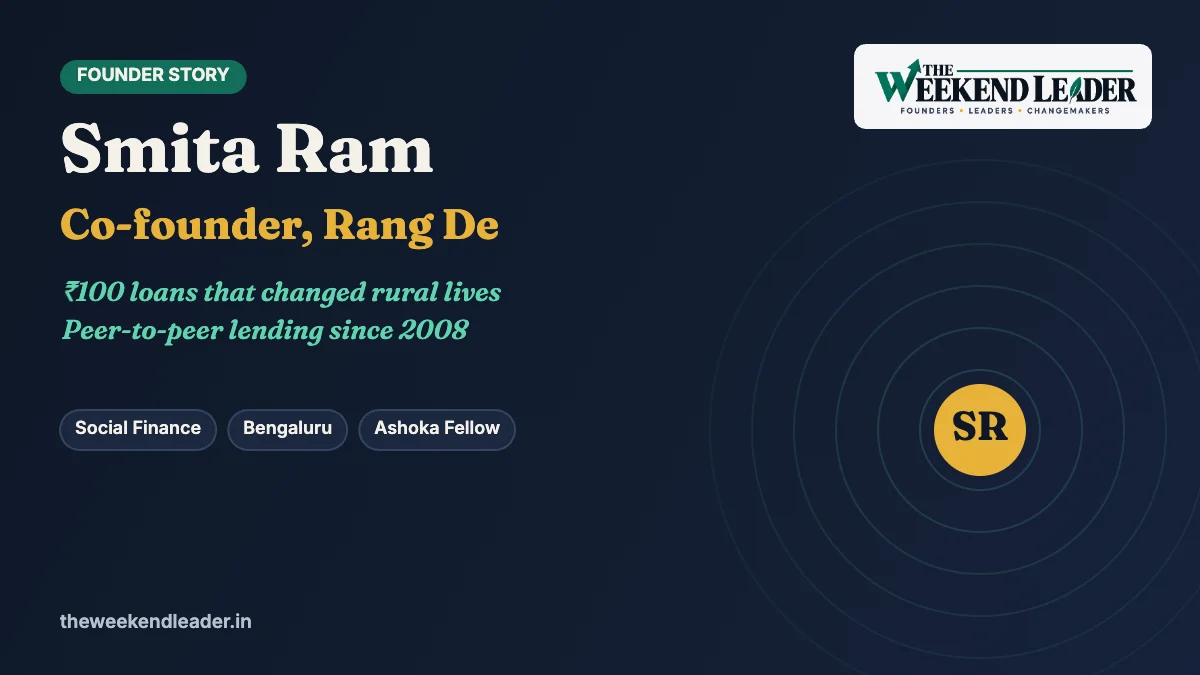
Smita Ram co-founded Rang De in Bengaluru in 2008 with her husband Ramakrishna NK. It began as a not-for-profit peer-to-peer microlending platform: ordinary Indians could lend as little as ₹100 at low interest to rural entrepreneurs, most of them women, who would otherwise pay high rates to moneylenders or microfinance lenders.
Who is Smita Ram, and what is Rang De? Smita Ram is a social entrepreneur and Ashoka Fellow (2012) who co-founded Rang De, an RBI-registered peer-to-peer (P2P) lending platform. Through it, thousands of individual “social investors” have funded low-cost loans for tens of thousands of rural and low-income borrowers across India. More than 93% of those borrowers are women.
Who is Smita Ram? Background
Smita Ram (also written Smita Ramkrishna) and Ramakrishna NK were working professionals in the UK when they started thinking about what credit costs India’s poor. Two things pushed them. Muhammad Yunus and Grameen Bank had just won the 2006 Nobel Peace Prize, which drew global attention to microcredit. At the same time, they saw that many Indian microfinance borrowers were paying interest rates far higher than the cost of capital justified.
We realised how credit, when given on fair terms, can help people overcome poverty.
Their question was simple: what if everyday people, not just institutions, could lend directly to a farmer, a tailor or a small shopkeeper at a fair rate? They returned to India and, on 26 January 2008, launched Rang De, putting in their own savings of about £6,000.
For more founders who built purpose-led organisations, see our guide to social entrepreneurs in India.
The business idea: peer-to-peer lending for social impact
The model had three parts:
- Social investors: individuals sign up online and lend in small amounts, starting from ₹100, to borrowers whose profiles they can see.
- Field partners: on-the-ground organisations identify borrowers, verify needs and collect repayments.
- Low-cost credit: borrowers paid a flat interest of roughly 4.5% to 10%, well below typical microfinance rates.
Investors earned a modest return and got their money back over time, which they could lend again. Loans paid for dairy animals, tailoring units, small shops, farming inputs and education.
Challenges: regulation, trust and scale
Rang De’s biggest test came from regulation. In 2017 the Reserve Bank of India issued its first guidelines for P2P lending platforms. They required registration as a non-banking financial company (NBFC-P2P) and a minimum net-owned fund, which a not-for-profit trust could not hold.
The founders had to rebuild the organisation as a private company to keep going. Their community stepped in. Smita Ram later told YourStory:
“We were able to file for a licence with RBI, thanks to 23 of our social investors who participated as equity investors.”
Those 23 investors came in as equity holders in January 2018. Freshworks founder Girish Mathrubootham was among the backers. The rebuilt platform went live in September 2019.
Earlier, the team had worked through slow years when awareness of online lending was low. They relied on grants and partners such as the ICICI Foundation, and later on Tata Trusts support (2015).
Growth journey: key milestones
| Year | Milestone |
|---|---|
| 2008 | Rang De launched on 26 January in Bengaluru as a not-for-profit P2P microlending platform |
| 2012 | Smita Ram named an Ashoka Fellow |
| 2013 | Platform opened to social investors outside India |
| 2015 | Support from Tata Trusts |
| 2017 | RBI issues P2P lending guidelines; Swabhimaan initiative launched in Kolar on 8 March. By then about ₹76 crore had been raised and disbursed |
| 2018 | 23 social investors become equity investors in the new company (January) |
| 2019 | New RBI-compliant platform goes live (September) |
By later reported figures, more than 15,000 social investors had lent about ₹80 crore to roughly 65,000 entrepreneurs.
Leadership lessons from Smita Ram
- Start with a fairness question. Rang De was built on the gap between what credit should cost and what poor borrowers actually paid.
- Your community is your capital. When regulation threatened the model, the platform’s own lenders became its shareholders.
- Treat regulation as a design input. Instead of shutting down, the founders restructured and became a licensed P2P platform.
- Put women at the centre. More than 93% of borrowers are women, and the Swabhimaan programme was built around them.
- Be patient. Impact finance builds trust slowly, over years, not quarters.
Read more lessons like these in what makes a good leader: 10 lessons from Indian CEOs and our profiles of women entrepreneurs in India.
What’s next for Rang De
As a regulated P2P platform, Rang De’s plan is to keep lending at the meeting point of financial returns and social impact. It wants to bring more individual investors into impact lending and to fund women-led enterprises, education and rural livelihoods through partner organisations.
FAQs
Who founded Rang De?
Smita Ram and Ramakrishna NK co-founded Rang De in Bengaluru on 26 January 2008.
What does Rang De do?
Rang De is a peer-to-peer lending platform. Individuals invest small amounts to fund low-cost loans for rural and low-income entrepreneurs, mostly women.
Is Rang De regulated by the RBI?
Yes. After the RBI’s 2017 P2P guidelines, Rang De restructured as a private company and applied for an NBFC-P2P licence. Its new platform launched in September 2019.
How much can you invest on Rang De?
Social investors could start lending from as little as ₹100 per loan on the original platform.
What is Smita Ram’s success story about?
It is about turning a fairness question about credit into a platform. With community support, that platform survived a major regulatory change and funded tens of thousands of borrowers.
Conclusion
The Smita Ram and Rang De story shows that finance can be built for people, not just profit. With about £6,000 of savings, a ₹100 entry point and a community willing to become shareholders, Rang De showed that ordinary Indians can be lenders to India’s small entrepreneurs.
Sources
Last updated: November 2026