
Most vehicle owners in an Indian city know the routine. A scooter won’t start, a car battery dies in a parking lot, or a service is overdue, and the next step is a phone call to a local mechanic who may or may not be free. Krunal Sinh Rana, the founder of Spinoto, is trying to turn that uncertain phone call into a booking with a time attached to it.
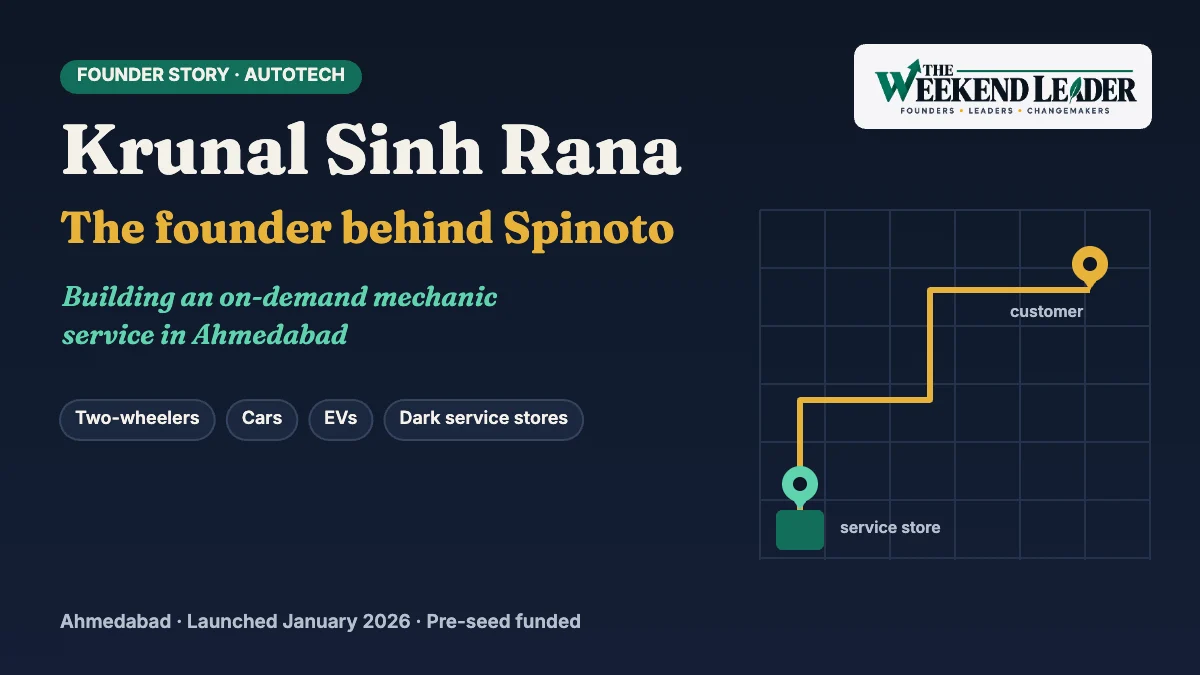
Spinoto is an Ahmedabad-based autotech startup that connects vehicle owners with mechanics and service providers through a single platform. It launched its on-demand mechanic service in Ahmedabad in January 2026 and announced a pre-seed funding round of $149,000 in September 2026. The company is young and still proving its model in one city, which makes this an early-stage founder story rather than a finished success story — and that is what makes it worth following.
Who is Krunal Sinh Rana, and what is Spinoto? Krunal Sinh Rana (also written Krunalsinh Rana or Krunal Rana) is the founder of Spinoto, an Ahmedabad-based autotech startup. Spinoto runs a platform that sends trained mechanics to vehicle owners for breakdowns, minor repairs, routine maintenance and basic EV diagnostics, covering two-wheelers, cars and electric vehicles.
Editor’s note: This profile is based on publicly available information, including company press releases and trade reporting. The Weekend Leader has not yet interviewed the founder. Details that could not be independently verified are marked as such.
Who is Krunal Sinh Rana?
Krunal Sinh Rana is an Ahmedabad entrepreneur and the founder of Spinoto. In company announcements he is described as Founder, and he is the only founder named in public reporting about the company.
According to Spinoto’s January 2026 launch announcement, the company was built on the founder’s “years of operational experience” in the automobile service sector. Beyond that description, details of his earlier roles have not been publicly documented in the sources we reviewed.
His public statements so far focus on the business rather than on himself: what the service covers, how it is organised, and how the company plans to grow. That is typical of an early-stage founder whose company is still being built, and it leaves room for a fuller interview-based profile later.
Early life, education and professional background
We could not find reliable public information about Krunal Sinh Rana’s early life, education or previous employers. Rather than speculate, this profile focuses on what is documented: his stated background in automobile service operations, and the decisions he has made in building Spinoto.
That background matters to the story. Vehicle repair is an operations-heavy business. Getting a mechanic, the right spare part and the right tools to a customer quickly depends on logistics, inventory and people management more than on an app alone. A founder who comes from the operational side of auto servicing is likely to see those constraints clearly — an analysis on our part, not a claim made by the company.
What is Spinoto and what does the company do?
Spinoto is an on-demand vehicle service platform based in Ahmedabad, Gujarat. Its tagline is “Mechanic in Minutes.” Through the platform, a vehicle owner can request help for a two-wheeler, passenger car or electric vehicle, and Spinoto assigns a nearby trained mechanic.
The services described in company announcements include:
- Breakdown and roadside assistance
- Minor repairs
- Routine maintenance and servicing
- Basic diagnostics for electric vehicles
- Workshop bookings and doorstep vehicle care
Explaining the scope at launch, Rana told Autocar Professional: “The App is designed to fill a variety of service needs, from breakdown assistance to minor repairs and routine maintenance.”
The company’s stated aim is broader than one-off repairs. In its funding announcement, Spinoto described itself as building “a technology-driven ecosystem that connects vehicle owners with automobile service providers through a single platform.” The company website is spinoto.com.
The business idea – why did Krunal Sinh Rana start Spinoto?
The founder has not publicly described a single moment that inspired the company, so we will not invent one. What the public record does show is the problem Spinoto set out to address.
Much of India’s vehicle servicing still runs through small, independent garages. For a customer, that often means uncertainty: how long the job will take, what it will cost, and whether the mechanic has the right part on hand. Spinoto’s launch announcement put the size of India’s vehicle service and aftermarket industry at an estimated ₹3.5–4 lakh crore a year — a company-cited estimate rather than an independently verified figure.
Spinoto’s response was to focus on speed and predictability. Its announcements emphasise digitally logged service requests, pricing estimates shared upfront, and verified mechanics. In other words, the idea is less about inventing a new kind of repair and more about making a familiar, fragmented service easier to book and trust.
How Spinoto works: dark service stores
The most distinctive part of Spinoto’s model is what it calls “dark service stores.” The term borrows from quick commerce, where “dark stores” are small warehouses that exist only to fulfil online orders quickly.
According to Autocar Professional and the company’s January 2026 announcement, Spinoto’s partner mechanics are based at these local stores, which hold common spare parts and standard tools. When a customer submits a request through the app, the system evaluates the reported problem, identifies the likely parts needed and assigns the nearest available mechanic, who arrives with those parts.
The logic is simple: much of the time lost in a breakdown goes into diagnosing the problem and then finding the part. By predicting the part before the mechanic leaves, Spinoto aims to reduce that delay. The company’s headline promise is a mechanic within 15 minutes of booking in its service areas; its launch release also says most tasks are completed within 30 minutes on site and full jobs typically within 45 minutes. These are company targets and claims, not independently measured results.
Challenges faced during the early stages
Krunal Sinh Rana has not spoken publicly about specific personal setbacks, so the challenges below are those that any on-demand vehicle service faces, drawn from Spinoto’s own statements and the nature of the industry.
Keeping the time promise. A 15-minute arrival target depends on traffic, mechanic availability and how densely stores are spread across a city. Spinoto has said its current focus in Ahmedabad is on response times, technician readiness and parts availability, which suggests these are the variables it is still tuning.
Building trust. Vehicle owners often stick with a mechanic they know. A new platform has to convince them that a stranger arriving at their doorstep will do good work at a fair price — hence the company’s emphasis on verified mechanics and upfront estimates.
Competition. India’s vehicle service market includes established platforms and countless neighbourhood garages. Third-party coverage of Spinoto’s funding listed GoMechanic, myTVS, ReadyAssist, Pitstop and Hoopy among players in the wider space.
Operating with limited capital. A $149,000 pre-seed round is modest for a business that needs physical stores, spare-parts inventory and trained mechanics. How efficiently Spinoto uses it will shape how quickly it can expand.
How Spinoto developed and grew
Spinoto’s public record is short, which is normal for a company in its first year. The verified milestones are:
| Date | Milestone | Significance |
|---|---|---|
| December 2025 | Company founded (as reported by third-party coverage; not confirmed in an official release) | Start of the business in Ahmedabad |
| 21 January 2026 | On-demand mechanic service launched in Ahmedabad (Autocar Professional) | First market; two-wheelers, cars and EVs covered |
| 27 January 2026 | Launch announcement details “dark service store” model (Tribune India, press release) | Sets out the operating model and expansion intent |
| 21 September 2026 | $149,000 pre-seed funding announced (Outlook Business, press release) | Funds for technology, product and operations; investors not disclosed |
Spinoto has not publicly disclosed customer numbers, revenue, the number of mechanics or the number of dark service stores, and its pre-seed investors have not been named. Readers should treat the company as early-stage.
Announcing the funding, Rana told Outlook Business: “We are moving from learning the market to building for scale.” He added: “This funding gives us the opportunity to strengthen our technology and operations.” The company said the money would go mainly into technology development, product improvements and operational systems.
Krunal Sinh Rana’s leadership and business philosophy
With no long-form interview available, we can only read the founder’s approach from his decisions and short public statements. Three patterns stand out.
Learn in one city first. Spinoto has repeatedly said it will strengthen its Ahmedabad model before expanding, and that expansion to Mumbai, Bengaluru, Delhi and Hyderabad depends on infrastructure, mechanic availability and service consistency. No timeline has been announced. That is a measured approach for an operations-heavy business.
Treat the problem as logistics. The dark-store model shows a focus on the physical bottlenecks — parts and people — rather than on the app alone.
Follow the shift to EVs. Including basic EV diagnostics from launch positions Spinoto for a segment where many independent mechanics are still building skills.
What makes Spinoto’s business model different?
Many vehicle service platforms work as marketplaces: they take a booking and pass it to a partner garage. Spinoto’s stated approach adds an inventory layer. By stationing mechanics at stores that already hold common parts, it is trying to control the two things that most often delay a repair.
The trade-off is cost. Stores, stock and trained staff make the model more capital-intensive than a pure booking app, and it only works if there are enough requests in each area to keep mechanics busy. That is why the company’s plan to perfect one city before expanding makes business sense. Whether the model can deliver its time promise profitably at scale is still unproven — and will be the key test for Spinoto over the next few years. This section is editorial analysis based on the company’s published description.
Leadership lessons aspiring entrepreneurs can learn from Krunal Sinh Rana
- Build from what you know. Spinoto draws on its founder’s stated background in automobile service operations. Starting in an industry you understand shortens the learning curve.
- Solve the slowest step. Instead of only making booking easier, Spinoto targets the delays that happen after booking — diagnosis and parts.
- Make a specific promise. “Mechanic in Minutes” is easy to understand and easy to measure. A clear promise also forces the business to build operations that can keep it.
- Prove the model locally. Ahmedabad comes first; other cities only once service is consistent. For capital-light founders, one market done well beats five done badly.
- Raise for a purpose. The pre-seed funds are earmarked for technology and operations, the two areas the model depends on.
- Watch where the market is moving. Covering EV diagnostics from the start reflects the growing number of electric two-wheelers and cars on Indian roads.
For more on building a business with limited capital, see our guides on how to start a business with no money in India and bootstrapping lessons from Indian founders.
Future vision – what’s next for Spinoto?
Spinoto’s publicly stated plans are to strengthen its operating model in Ahmedabad and then expand in phases to Tier 1 cities including Mumbai, Bengaluru, Delhi and Hyderabad. The company has said it wants to build a broader vehicle-ownership service ecosystem rather than only a repair app. No expansion dates, new funding rounds or product launches beyond these statements have been announced.
Frequently asked questions about Krunal Sinh Rana and Spinoto
Who is Krunal Sinh Rana?
Krunal Sinh Rana, also written Krunalsinh Rana, is the founder of Spinoto, an autotech startup based in Ahmedabad. According to the company, he built Spinoto drawing on years of operational experience in the automobile service sector. Further details of his education and earlier career have not been publicly documented.
Who is the founder of Spinoto?
Spinoto was founded by Krunal Sinh Rana, who is named as Founder in the company’s launch and funding announcements. He is the only founder identified in public reporting about the company.
What does Spinoto do?
Spinoto runs an on-demand vehicle service platform in Ahmedabad. Customers book through an app, and the company assigns a nearby trained mechanic from a local “dark service store” stocked with common parts and tools, for breakdowns, minor repairs, maintenance and basic EV diagnostics.
What is the success story of Krunal Sinh Rana?
It is an early-stage story. Krunal Sinh Rana launched Spinoto’s on-demand mechanic service in Ahmedabad in January 2026 and announced $149,000 in pre-seed funding in September 2026. Customer numbers and revenue have not been disclosed, and expansion to other cities is planned but not yet scheduled.
What can aspiring entrepreneurs learn from Krunal Sinh Rana?
His approach shows the value of building in a familiar industry, targeting the slowest step in a customer’s experience, making a clear and measurable promise, and proving a model in one city before expanding.
The entrepreneurial journey of Krunal Sinh Rana
Krunal Sinh Rana’s story is still being written. In less than a year, the Spinoto founder has launched an on-demand mechanic service in Ahmedabad, set out a distinctive dark-store model, and raised a small pre-seed round to strengthen technology and operations. What the company has not yet shown publicly — customer numbers, unit economics, a second city — will decide whether that early promise holds.
For aspiring founders, the useful lesson is in the approach: pick a familiar, frustrating problem, design operations around the real bottleneck, and grow only as fast as the service stays reliable. Many of India’s first-generation entrepreneurs and startups from smaller cities started in exactly this way. The Weekend Leader will follow Spinoto’s progress and hopes to speak with its founder directly.
Sources
- Spinoto launches 15-minute on-demand mechanic service in Ahmedabad — Autocar Professional, 21 January 2026
- Spinoto introduces 15-minute on-demand mechanic service — Tribune India (PNN press release), 27 January 2026
- Spinoto raises USD 149K in pre-seed funding — Outlook Business (PNN press release), September 2026
- Spinoto raises $149K to make vehicle servicing faster — Newskart, September 2026
- Spinoto official website
Last updated: November 2026. Company claims are attributed and have not been independently verified by The Weekend Leader.