
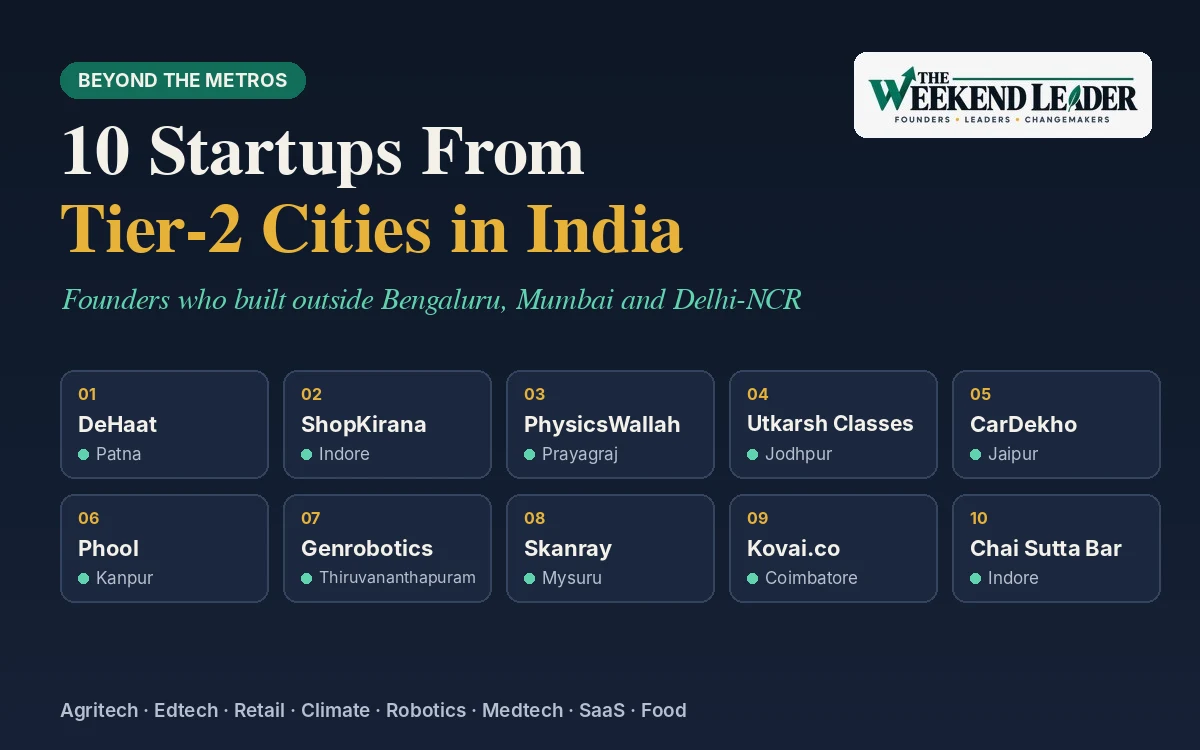
Some of India’s most useful startups were not built in Bengaluru, Mumbai, Delhi-NCR or Hyderabad. If you are looking for startups from tier 2 cities India can point to, start with these ten: DeHaat (Patna), ShopKirana and Chai Sutta Bar (Indore), PhysicsWallah (Prayagraj), Utkarsh Classes (Jodhpur), CarDekho (Jaipur), Phool (Kanpur), Genrobotics (Thiruvananthapuram), Skanray Technologies (Mysuru) and Kovai.co (Coimbatore).
What links them is not a sector. A farmer in Bihar, a kirana owner in Madhya Pradesh, a student preparing for a government exam in Rajasthan, a sanitation worker in Kerala — each faced a problem that founders in their own region saw up close. Some of these companies stayed home. Others started in a smaller city and later moved their headquarters. Both stories matter, and this list is clear about which is which.
A quick note on the label. “Tier-2” is used loosely in India. Here it follows the central government’s house rent allowance classification, which groups cities as X, Y and Z; Y-class cities are what most people mean by Tier-2. All ten cities below are Y-class.
What makes Tier-2 cities important for startups?
The biggest reason is the market itself. Millions of customers in smaller cities and the villages around them are underserved by products designed for metro buyers. A founder who grew up near those customers often understands their habits, language and budget better than anyone in a metro office.
Costs can help too. Office rent and some salaries may be lower than in Bengaluru or Mumbai, although that is not true everywhere or for every role — specialised engineers, for example, can be hard to hire at any price. Cheap smartphones and data have also made it possible to reach customers well beyond one city from day one.
Finally, there are problems that only make sense locally: temple flower waste on the Ganga, manual sewer cleaning in Kerala, or small farm plots in Bihar. Business opportunities in tier 2 cities depend heavily on local networks, infrastructure and access to funding, so the picture differs a lot from Indore to Patna to Coimbatore.
10 startups from Tier-2 cities in India
1. DeHaat — Patna, Bihar (Agritech)
Founded: 2012 · Founders: Shashank Kumar, Shyam Sundar, Amrendra Singh, Adarsh Srivastava and Abhishek Dokania
Shashank Kumar was born into a farming family in Bihar’s Chhapra district, studied at IIT Delhi and worked as a supply-chain consultant before returning to Bihar to start DeHaat. The problem he saw was fragmentation: smallholder farmers buy seeds from one place, get advice from another, borrow from a third and sell to a middleman who sets the price.
DeHaat’s answer was to put inputs, crop advice and market access under one roof, close to the farm. Its distinctive move was the franchise model: locally trained micro-entrepreneurs run DeHaat centres that serve farmers within a few kilometres, backed by an app and a helpline. The company remains based in Patna, which makes it one of the clearest examples of a regional startup ecosystem producing a national-scale agritech business.
2. ShopKirana — Indore, Madhya Pradesh (B2B e-commerce)
Founded: 2015 · Founders: Sumit Ghorawat, Deepak Dhanotiya and Tanutejas Saraswat
Deepak Dhanotiya’s father ran a kirana shop for years and struggled with the same issues as millions of small retailers: running out of stock, ordering blind and waiting on distributors. ShopKirana, launched in Indore in early 2015, built a mobile app that lets kirana owners order from many brands in one place, with next-day delivery and cash on delivery.
Early coverage described an asset-light approach that earned mainly through commissions from brands, with logistics and credit services added on top. The company later raised larger rounds, including a $38 million Series C in January 2022. ShopKirana matters because it shows that the business-to-business supply chain behind neighbourhood shops — not just consumer apps — is a real opportunity for startups in non-metro cities.
3. PhysicsWallah — started in Prayagraj, now headquartered in Noida (Edtech)
Founded: 2016 as a YouTube channel; company formed in 2020 · Founders: Alakh Pandey and Prateek Maheshwari
PhysicsWallah began as Alakh Pandey’s free YouTube channel in Prayagraj, teaching physics to students preparing for JEE and NEET. Its pitch was simple: good teaching should not depend on whether a family can afford expensive coaching in Kota or Delhi. When the company was set up in 2020, it kept course prices low and built on the audience the channel had already earned.
It became a unicorn in June 2022 and listed on the NSE and BSE in November 2025. Its headquarters is now in Noida, so it is best described as a startup that originated in a Tier-2 city. That still makes it one of the most visible startup success stories in India to come from outside a metro.
4. Utkarsh Classes & Edutech — Jodhpur, Rajasthan (Exam-prep edtech)
Started: 2002 as an offline institute; app launched in 2018 · Founders: Dr Nirmal Gehlot and Tarun Gehlot
Utkarsh is older than most companies on this list. The Gehlot brothers started with two rented rooms in Jodhpur, coaching students for central and state government exams. The startup phase came later: YouTube channels in 2017 and the Utkarsh learning app in 2018, which let the institute reach aspirants far beyond Rajasthan.
By July 2022, the company said it had taught more than 20 million students since inception. Its online courses were priced far below its offline programmes, which is the core of its approach: keep coaching affordable for aspirants from smaller towns. In 2023, PhysicsWallah announced a joint venture with Utkarsh — a neat sign of two edtech companies with Tier-2 roots working together.
5. CarDekho Group — Jaipur, Rajasthan (Auto marketplace)
Founded: 2008 (parent GirnarSoft, 2007) · Founders: Amit Jain and Anurag Jain
The Jain brothers, both IIT Delhi graduates, first ran GirnarSoft as a software outsourcing firm from Jaipur. CarDekho grew out of that business in 2008 as a website where buyers could research and compare cars — useful in a market where reliable prices and specifications were hard to find.
The group has since added brands such as BikeDekho, ZigWheels and InsuranceDekho, and it became a unicorn in October 2021 after a $250 million round. CarDekho is often cited as proof that a consumer internet company can be built from Jaipur and still compete nationally. Its public profile lists Jaipur as headquarters, although the group operates offices in other cities too.
6. Phool — Kanpur, Uttar Pradesh (Circular economy and climate)
Founded: 2017 · Founders: Ankit Agarwal and Prateek Kumar
Every day, flowers offered at temples end up as waste, much of it in rivers like the Ganga. Phool, based in Kanpur, collects that floral waste and turns it into products: incense cones, vermicompost, a biodegradable alternative to thermocol called Florafoam, and a plant-based leather alternative called Fleather.
What makes the model unusual is that the raw material is a local waste stream that most people ignore. The company also employs more than 300 women from marginalised backgrounds, according to its public profile. Phool is a good example of emerging startups in India that sit at the meeting point of climate, livelihoods and consumer products — and it could only have started somewhere close to the problem.
7. Genrobotics — Thiruvananthapuram, Kerala (Robotics for sanitation and healthcare)
Founded: 2017 · Founders: Vimal Govind MK, Arun George, Rashid K and Nikhil NP
Genrobotics began as a project by four engineering friends from MES College of Engineering, Kuttipuram, who wanted to end the dangerous practice of people entering manholes to clean sewers. Their robot, Bandicoot, launched in 2018 with the Kerala Water Authority as its first client; operators control it from above ground, so no worker has to go down.
The company has since moved into healthcare with G-Gaiter, a gait-training robot for rehabilitation used in private and government hospitals. By August 2025, its robots were deployed across 22 Indian states and four countries, according to The Week. Genrobotics shows that deep-tech hardware, often assumed to need a metro lab, can be built from Kerala’s capital.
8. Skanray Technologies — Mysuru, Karnataka (Medical devices)
Beginnings: 2007 · Founder: Vishwaprasad Alva (founder and managing director)
Skanray makes medical equipment in India — X-ray and dental imaging systems, patient monitors, defibrillators and critical-care ventilators — with its registered office in Mysuru’s Hebbal Industrial Area. India imports a large share of its medical devices, so a domestic manufacturer with its own designs fills a real gap.
Its importance became visible in March 2020, at the start of the pandemic. News reports compiled by DRDO that month described Skanray as one of the few domestic ventilator makers, said its Mysuru plant made about 200 ventilators a month and was planning a rapid scale-up, and quoted Alva saying the company was “opening up our design IP” so others could manufacture. For founders, Skanray is a reminder that manufacturing-led companies can grow outside metros too.
9. Kovai.co — Coimbatore, Tamil Nadu (Enterprise SaaS)
Founded: 2011 · Founder: Saravana Kumar
Saravana Kumar, born and raised in Coimbatore, spent years as a Microsoft BizTalk consultant before turning a side project into BizTalk360, a tool for monitoring BizTalk Server. That became Kovai.co, which now also sells Document360, a knowledge-base platform, and Turbo360 for Azure cloud management. The company has offices in Coimbatore and London, with Coimbatore as its development hub.
Its distinctive choice is funding: Kovai.co is bootstrapped. In December 2025 it said Document360 had crossed $10 million in annual recurring revenue and announced a planned ₹220 crore investment in its Coimbatore development centre. It is a strong counterpoint to the idea that global software companies need venture capital and a Bengaluru address.
10. Chai Sutta Bar — Indore, Madhya Pradesh (Consumer food and beverage)
Founded: 2016 · Founders: Anubhav Dubey and Anand Nayak
Chai Sutta Bar opened its first tea café outside a girls’ hostel in Indore with about ₹30 lakh of capital. The idea was familiar — tea in a clay kulhad at a youth-friendly price — but the execution was built for scale through franchising.
By late 2021, YourStory reported more than 200 outlets in about 100 cities, almost all of them franchise-run, and said the chain sourced around three lakh kulhads a day from roughly 500 potter families. That last detail is what sets it apart: the brand’s growth also supports a traditional craft. It is one of the better-known entrepreneurs-from-tier-2-cities stories in consumer retail.
Summary: 10 startups from Tier-2 cities at a glance
| Startup | City | Industry | Founded |
|---|---|---|---|
| DeHaat | Patna, Bihar | Agritech | 2012 |
| ShopKirana | Indore, Madhya Pradesh | B2B e-commerce | 2015 |
| PhysicsWallah | Prayagraj, UP (HQ now Noida) | Edtech | 2016 / 2020 |
| Utkarsh Classes & Edutech | Jodhpur, Rajasthan | Exam-prep edtech | 2002 (app 2018) |
| CarDekho Group | Jaipur, Rajasthan | Auto marketplace | 2008 |
| Phool | Kanpur, UP | Circular economy | 2017 |
| Genrobotics | Thiruvananthapuram, Kerala | Robotics | 2017 |
| Skanray Technologies | Mysuru, Karnataka | Medical devices | 2007 |
| Kovai.co | Coimbatore, Tamil Nadu | Enterprise SaaS | 2011 |
| Chai Sutta Bar | Indore, Madhya Pradesh | Food and beverage | 2016 |
What can entrepreneurs learn from these startups?
- Start with a problem you can see. DeHaat came from a farming family’s reality; ShopKirana from a father’s kirana shop; Genrobotics from the danger of manual sewer cleaning.
- Know the customer before you scale. PhysicsWallah built an audience on YouTube for years before it charged for courses.
- Build a model that pays for itself. Kovai.co grew without venture capital by selling software customers were willing to pay for.
- Use technology to leave the city limits. Utkarsh went from two rooms in Jodhpur to a national app; CarDekho went national from Jaipur.
- Partner locally. Genrobotics’ first client was the Kerala Water Authority. Chai Sutta Bar works with potter families for its kulhads.
- Earn trust through quality. In medical devices, as Skanray shows, reliability is the product.
- Expand when the model is ready. Franchising worked for Chai Sutta Bar because the format was simple to copy.
Many of these founders are also first-generation entrepreneurs in India, which makes the lessons easier to apply for anyone starting without a business family behind them.
Challenges faced by startups outside major metros
The hardest gap is usually capital. Most venture firms and institutional investors are concentrated in Bengaluru, Mumbai and Delhi-NCR, so founders elsewhere often travel more and wait longer for meetings. Hiring is the next hurdle: senior engineers, product managers and sales leaders may prefer metro jobs, and retaining them can be harder still.
Mentorship and peer networks are thinner, although incubators and chapters of groups like TiE are growing in many cities. Logistics, power and connectivity can vary, and a product built for one regional market may need real changes before it works in another. None of these challenges is the same everywhere — Coimbatore’s software talent pool, for example, is very different from a smaller city’s — and some companies, like PhysicsWallah, eventually moved their headquarters to a metro.
Frequently asked questions
What are some startups from Tier-2 cities in India?
Well-known examples include DeHaat (Patna), ShopKirana and Chai Sutta Bar (Indore), PhysicsWallah (started in Prayagraj), Utkarsh Classes (Jodhpur), CarDekho (Jaipur), Phool (Kanpur), Genrobotics (Thiruvananthapuram), Skanray Technologies (Mysuru) and Kovai.co (Coimbatore).
Why are startups emerging in Tier-2 cities?
Because large, underserved markets sit close to these cities, smartphones and cheap data make it possible to reach customers anywhere, and founders who grew up locally understand problems that metro companies often miss. Costs can also be lower in some places, though not in all.
Which industries offer startup opportunities in smaller Indian cities?
Agritech, education and exam preparation, retail supply chains, food and beverage, healthcare and medical devices, waste and climate solutions, and software services are all represented on this list. The right sector depends on the local economy and the problems customers face.
Is it possible to build a successful startup outside a metro city?
Yes. CarDekho became a unicorn while based in Jaipur, Kovai.co built multi-million-dollar software products from Coimbatore without venture capital, and DeHaat grew from Patna. Success still depends on the business model, the team and access to customers and capital.
What challenges do Tier-2 city startups face?
The main ones are limited access to venture capital, difficulty hiring and keeping specialised talent, fewer mentors and industry networks, uneven infrastructure, and the work of expanding beyond the home market. How serious each one is varies by city and by business.
Conclusion
These ten companies show that the Indian startup ecosystem is wider than its best-known postcodes. They come from different sectors — farming, retail, education, robotics, medical devices, software and tea — but they share a habit: each started with a problem the founders could see clearly, often because it was in their own city or family.
That is the most practical takeaway for anyone thinking about a business outside a metro. You do not need to copy a Bengaluru playbook. Find a real problem, understand the people who live with it, and build something that can pay for itself before you try to grow fast.
Key takeaway: Startups from India’s Tier-2 cities, such as DeHaat in Patna, CarDekho in Jaipur and Kovai.co in Coimbatore, have grown by solving local problems first and using technology to reach national and global customers.
Sources
- Classification of Indian cities (HRA X/Y/Z) — Wikipedia
- DeHaat founder story — The Better India; DeHaat — Wikipedia
- Indore-based ShopKirana — YourStory; ShopKirana story — Inc42; Series C — YourStory
- Physics Wallah — Wikipedia
- Utkarsh Classes — YourStory; PhysicsWallah–Utkarsh JV — Inc42
- CarDekho Group — Wikipedia; CarDekho’s Jaipur roots — Inc42
- Phool — Wikipedia; Phool profile — Outlook Business
- Genrobotics — Outlook Business; Genrobotics and G-Gaiter — The Week
- Skanray contact and registered office — Skanray; News clippings, 24 March 2020 — DRDO
- Kovai.co’s Document360 crosses $10M ARR — CXOToday; Kovai.co story — StartupTalky
- Chai Sutta Bar — YourStory
Last updated: October 2026. Figures are given with the year of the source and may have changed since.