

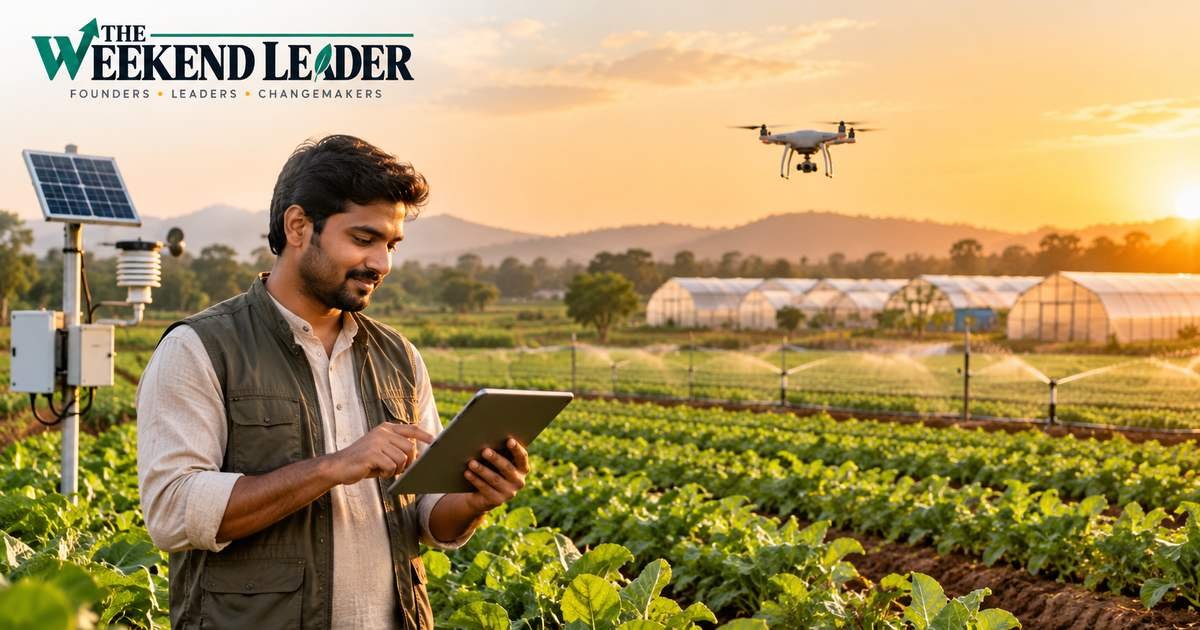
The average Indian farm is about 1.08 hectares — roughly the size of one and a half football pitches. According to the 2015–16 Agriculture Census, 86% of the country’s farm holdings are under two hectares. That single fact shapes almost everything about Indian agriculture: who a farmer can sell to, how much they can borrow, whether they can afford a soil test, and how much a bad monsoon hurts.
It is also the problem that a generation of agritech startups in India has tried to solve. Their founders came from consulting firms, banks, software companies and farming families. Some built marketplaces, others warehouses, sensors or data platforms. This article looks at seven agritech startups and their founders — DeHaat, Ninjacart, AgroStar, Arya.ag, Bijak, Fasal and Cropin — and what each has actually achieved, including where the numbers have been disappointing.
What are agritech startups? Agritech startups are young companies that use technology or new business models to improve some part of farming — from seeds, advice and credit before a crop is planted, to storage, logistics and sales after it is harvested.
Why agritech startups are gaining attention in India
Three things came together in the 2010s. Cheap smartphones and data reached rural India, making it possible to sell to farmers and advise them remotely. Large buyers — retailers, food processors, exporters — wanted more consistent supply and quality than traditional mandis offered. And investors saw a vast, fragmented market where even small efficiency gains could add up.
Money followed, and then retreated. Agritech funding in India peaked at about $1.17 billion in 2021 and fell to about $182 million in 2025, according to Tracxn data cited by Entrepreneur India. Investors interviewed for that report pointed to a shift towards profitability and a rethink of asset-light marketplace models, many of which have disappeared. That reset is the backdrop for every company below: the question is no longer only whether a model helps farmers, but whether it can pay for itself.
Agritech founders transforming Indian farming
DeHaat — Shashank Kumar and co-founders: one counter for everything a farmer needs
Shashank Kumar grew up in a farming family in Bihar, studied at IIT Delhi and worked as a supply-chain consultant before founding DeHaat in 2012 with Shyam Sundar, Amrendra Singh, Adarsh Srivastava and Abhishek Dokania. The company is based in Patna.
The insight was fragmentation. A smallholder buys seed from one shop, gets advice from another person, borrows from a third and sells to a trader who sets the price. DeHaat tried to put all of that in one place, through franchise-run centres operated by trained local micro-entrepreneurs, backed by an app.
The scale is real: DeHaat reported revenue of more than ₹3,000 crore for FY25 and says it works with over 13 million farmers across 11 states, Inc42 reported in October 2025. But the shape of that revenue is revealing. More than 79% came from output linkages — buying and selling farm produce — a thin-margin trading business that competes with informal traders who have lower overheads. Its FY25 profit of ₹369 crore came mainly from non-cash gains; on an operating basis, it lost about ₹207 crore. DeHaat says it reached EBITDA breakeven in the first quarter of FY26.
DeHaat’s lesson is that a farmer-facing network can be built at scale. Turning it into a profitable business is the harder, still unfinished part.
Ninjacart — Thirukumaran Nagarajan and team: moving vegetables faster
Ninjacart was founded in Bengaluru in 2015 by Thirukumaran Nagarajan, now CEO, with Ashutosh Vikram, Kartheeswaran KK, Sharath Loganathan, Vasudevan Chinnathambi and Sachin Jose. It began as a hyperlocal grocery delivery service, then pivoted to the supply chain behind it.
Fresh produce is perishable, prices swing daily, and a tomato can change hands several times between farm and shop. Ninjacart’s model is to buy from farmers and sell directly to retailers, restaurants and other businesses, using collection centres, warehouses and its own logistics to shorten that chain. Walmart and Flipkart have backed it, including a $145 million round in December 2021.
The financial picture shows the cost of running physical supply chains. Ninjacart’s revenue fell to ₹1,634 crore in FY25 from ₹2,007 crore the year before, as it shut low-margin, non-core segments, and it posted a loss of ₹256 crore, according to PTI. The company says its core verticals are now operationally profitable and it is targeting overall profitability in FY27.
Choosing to shrink revenue to fix margins is a hard decision for a venture-backed company, and an instructive one for any founder in a capital-heavy business.
AgroStar — Shardul and Sitanshu Sheth: discovering the real gap was knowledge
Brothers Shardul and Sitanshu Sheth left corporate careers — Shardul at PwC and Best Buy in the US, Sitanshu at KPMG India — to found AgroStar in Pune in March 2013. They first assumed the main problem was poor-quality seeds, fertilisers and pesticides.
Farmers’ calls told them otherwise. Most callers wanted to know how to use the products, which suggested the bigger gap was reliable advice. AgroStar built an advisory centre staffed by agronomists — its “agri doctors” — alongside an app and an input-selling business, and later a network of partner retail stores. In 2022 the company told YourStory it had served more than five million farmers through its app and input platform.
The revenue still comes almost entirely from products. AgroStar’s operating revenue rose to ₹853 crore in FY25, with product sales making up about 97%, while its net loss fell by about 56% to ₹143.5 crore, Entrackr reported in March 2026. Advice builds trust; selling inputs pays for it. That is a common pattern in Indian agritech, and it raises a fair question about how independent paid-for advice can be.
Arya.ag — Prasanna Rao, Anand Chandra and Chattanathan Devarajan: helping farmers wait
Many farmers sell immediately after harvest, when prices are usually at their lowest, because they need cash. Prasanna Rao, a former commodity-finance executive at ICICI Bank, saw that banks rarely reached the places where grain was grown, and their loans did not suit small farmers or aggregators.
Arya.ag, founded in 2013 with Anand Chandra and Chattanathan Devarajan, grew in layers: warehouse management, then storage it operated itself, then a lending arm, Aryadhan Financial Services, licensed in 2018, which gives loans against stored produce. A marketplace connecting farmers, farmer producer organisations (FPOs) and buyers followed in 2021, Inc42 reported. The idea is simple: if a farmer can store grain safely and borrow against it, they can choose when to sell.
Unusually for the sector, Arya.ag is profitable. It reported FY25 revenue of ₹425 crore and profit of ₹32 crore, and in January 2026 raised ₹725 crore in a Series D led by GEF Capital Partners. The company says it operates about 12,000 warehouses and enables about $1.5 billion of credit a year — company figures, not independently audited ones. Its lesson: solving a financing problem with physical infrastructure can create a defensible, profitable business, even if it is slower to build.
Bijak — Nukul Upadhye and co-founders: building for the trader, not around them
Most agritech pitches promise to cut out middlemen. Bijak took the opposite view. Founded by Nukul Upadhye, Nikhil Tripathi, Mahesh Jakhotia, Daya Rai and Jitender Bedwal, it began operations in April 2019 from a mandi in Kannauj, Uttar Pradesh, and built tools for the traders who move most of India’s farm produce.
Its app offered buyer and supplier lists, mandi rates, ratings, digital ledgers and access to short-term credit, aimed at a trade that runs on trust and informal payment terms, according to YourStory. Bijak earned through transaction fees and lending partnerships.
Growth has been uneven. Bijak’s gross merchandise value fell 25% to ₹551 crore in FY25, and its loss rose to ₹61 crore despite a 22% cut in expenses, Entrackr reported in April 2026. Commodity sales made up almost all its income. Bijak shows that working with the existing system is a sharp insight, but trading-heavy models still face thin margins and working-capital pressure.
Fasal — Ananda Verma and Shailendra Tiwari: precision farming for high-value crops
Ananda Verma and Shailendra Tiwari, both from farming families in Uttar Pradesh, left corporate jobs to start Fasal in Bengaluru in 2017. Their focus is horticulture — fruit, vegetables and other high-value crops where water and pesticide decisions directly affect income.
Fasal’s device, Fasal Kranti, is a solar-powered unit with more than a dozen sensors that track soil and weather conditions on the farm. Its app turns that data into recommendations on irrigation, pest and disease risk, in local languages. This is precision farming in India in its most practical form: telling a farmer when to water and when not to spray.
The impact claims are promising but need care. A case study on NITI Aayog’s Frontier Tech Hub — published as a user submission, not verified by NITI — reports farmer-reported pesticide savings of up to 60% and yield gains of up to 40%, and says the system covers about 10,000 acres. Those are company and farmer reports, not independent trials. The larger limitation is cost: sensor hardware makes most sense on high-value crops, which is why Fasal targets horticulture rather than every smallholding.
Cropin — Krishna Kumar and Kunal Prasad: selling data to the businesses around farmers
Krishna Kumar and Kunal Prasad, both from Jharkhand, left corporate jobs to found Cropin in Bengaluru in 2010, with Chittaranjan Jena, who left in 2019. Cropin chose a business-to-business route: it sells farm-management and data software to seed companies, food processors, lenders, insurers and governments, which then use it to work with farmers.
That choice avoided the high cost of selling to millions of individual farmers and helped Cropin grow abroad — in 2021 it said about 60% of its revenue came from international markets. In July 2024, it launched Sage, an agri-intelligence tool built with Google’s Gemini models that maps farmland in fine grids and forecasts crop performance. Cropin says it has digitised about 30 million acres and serves more than 250 business customers.
These are company figures. The model’s strength — scaling through enterprises — is also its limit: the value reaches farmers only if the businesses using the data pass the benefits on.
Comparing the agritech startups and their founders
| Startup | Founders | Founded / base | Problem addressed | Model | Latest reported numbers |
|---|---|---|---|---|---|
| DeHaat | Shashank Kumar, Shyam Sundar, Amrendra Singh, Adarsh Srivastava, Abhishek Dokania | 2012, Patna | Fragmented inputs, advice and selling | Full-stack network of franchise centres | FY25 revenue over ₹3,000 Cr; operating loss ~₹207 Cr |
| Ninjacart | Thirukumaran Nagarajan and co-founders | 2015, Bengaluru | Slow, wasteful fresh-produce supply chain | Farm-to-business sourcing and logistics | FY25 revenue ₹1,634 Cr; loss ₹256 Cr |
| AgroStar | Shardul Sheth, Sitanshu Sheth | 2013, Pune | Lack of reliable crop advice | Advisory plus input sales and retail | FY25 revenue ₹853 Cr; loss ₹143.5 Cr |
| Arya.ag | Prasanna Rao, Anand Chandra, Chattanathan Devarajan | 2013 | Distress sales after harvest | Storage, storage-backed credit, marketplace | FY25 revenue ₹425 Cr; profit ₹32 Cr |
| Bijak | Nukul Upadhye, Nikhil Tripathi, Mahesh Jakhotia, Daya Rai, Jitender Bedwal | 2019, Gurugram | Trust and credit in agri trade | B2B trading platform for traders | FY25 GMV ₹551 Cr; loss ₹61 Cr |
| Fasal | Ananda Verma, Shailendra Tiwari | 2017, Bengaluru | Guesswork in irrigation and spraying | IoT sensors and app for horticulture | ~10,000 acres (company-reported) |
| Cropin | Krishna Kumar, Kunal Prasad | 2010, Bengaluru | No reliable farm data for agribusinesses | B2B farm-data and AI software | ~30M acres digitised (company-reported) |
How agritech startups are changing farmers’ access to markets
Farm-to-market platforms like DeHaat, Ninjacart and Arya.ag try to give farmers more buyers, better price information or more time to sell. When they work, farmers can sell graded produce to a retailer or processor instead of accepting whatever the nearest trader offers.
The constraints are practical. Transport is expensive for small volumes. Large buyers demand consistent quality, which a small farm cannot always guarantee. Prices still swing with weather and demand, and conditions in a Bihar vegetable belt differ from those in a Maharashtra cotton district. That is why aggregation through FPOs, cooperatives or local entrepreneurs keeps appearing: one farmer’s harvest is rarely enough for a platform to move profitably.
The role of AI, data and precision agriculture
Some technologies are already in commercial use: on-farm sensors that guide irrigation, phone-based pest and disease advice, satellite-based crop monitoring, and weather alerts. Fasal and Cropin are examples of tools sold today.
Others are still emerging. Generative AI tools like Cropin’s Sage, which answer questions about crop performance, are new, and their accuracy across India’s many crops and microclimates is still being tested. AI in agriculture can reduce guesswork; it cannot remove the uncertainty of weather, pests or markets. Good data also depends on ground truth — field visits, soil samples and farmer records — which is expensive to collect.
Challenges agritech founders must overcome
- Small holdings: with average farms around one hectare, the revenue per farmer is small and the cost of reaching each one is high.
- Trust and digital literacy: farmers often rely on people they know; an app alone rarely earns trust.
- Language and regional differences: crops, practices and languages change from district to district.
- Affordability: hardware and paid services must pay back within a season or two.
- Data quality: records on land, yields and prices are patchy.
- Last-mile delivery: getting inputs to villages and produce out of them costs money.
- Seasonality and working capital: revenue is uneven, while stock and credit need cash upfront.
- Competition and sustainability: informal traders and input dealers work on low overheads.
- Climate risk: floods, heat and erratic rain can wipe out a season’s gains.
That is why promising technology does not automatically spread. A tool can work perfectly in a pilot and still fail if it is too expensive, too complex, or not backed by someone farmers trust.
What makes an agritech startup successful in India?
The seven companies point to a few patterns, though none is a guarantee.
- Start from what farmers actually need. AgroStar changed course when calls showed advice mattered more than products.
- Combine digital tools with people on the ground. DeHaat’s local entrepreneurs and AgroStar’s agronomists do work an app cannot.
- Make the unit economics work. Arya.ag’s profitability and Ninjacart’s decision to cut low-margin lines both show how much this matters.
- Choose the right customer. Cropin sells to businesses; Bijak to traders; Fasal to high-value growers. Each choice shapes the business.
- Partner widely. FPOs, cooperatives, lenders and distributors extend reach far more cheaply than going it alone.
- Prove value in rupees. Farmers adopt what saves money or raises income within a season.
Many of these founders are first-generation entrepreneurs, and several have changed direction more than once. Our piece on how Indian founders survived early failures and setbacks explores that pattern in more detail.
The future of India’s agritech ecosystem
The most realistic opportunities sit where agritech solves an expensive problem that farmers or buyers already pay to fix: post-harvest storage and credit, as Arya.ag shows; advice tied to inputs; precision tools for high-value crops; and data services for lenders, insurers and processors. Climate-smart practices — saving water, reducing chemical use — are likely to matter more as weather becomes harder to predict.
For more farmers to benefit, a few things need to improve: better aggregation through FPOs, cheaper and more reliable rural logistics, credit that reaches small farmers, and evidence of impact that is independently measured rather than self-reported. After the funding boom and correction, the companies that remain are the ones learning to grow on revenue rather than capital.
Frequently asked questions
What are agritech startups in India?
Agritech startups in India are young companies that use technology or new business models to improve farming — through advice, inputs, credit, storage, logistics, market access or farm data. Examples include DeHaat, Ninjacart, AgroStar, Arya.ag, Bijak, Fasal and Cropin.
Who are some leading agritech startup founders in India?
Notable founders include Shashank Kumar (DeHaat), Thirukumaran Nagarajan (Ninjacart), Shardul and Sitanshu Sheth (AgroStar), Prasanna Rao (Arya.ag), Nukul Upadhye (Bijak), Ananda Verma and Shailendra Tiwari (Fasal), and Krishna Kumar and Kunal Prasad (Cropin). This selection is illustrative; “leading” depends on whether you measure revenue, reach, profit or impact.
How are agritech startups helping Indian farmers?
They help by giving farmers access to crop advice, quality inputs, more buyers, storage, loans against stored produce, and data-driven guidance on irrigation and pests. The benefits depend on cost, trust and local delivery, and many impact figures are still company-reported.
Which technologies are being used in Indian agriculture?
Common technologies include mobile apps and call-centre advisory, IoT soil and weather sensors, satellite crop monitoring, digital marketplaces, warehouse management systems, and increasingly AI models for yield forecasting and pest detection. Drones are used for spraying and surveys in some regions.
What challenges do agritech startups face in India?
The main challenges are small landholdings, low farmer trust in new platforms, regional and language differences, affordability, patchy data, costly last-mile delivery, seasonal cash needs, thin trading margins and climate risk. Funding also fell sharply after 2021.
How can someone start an agritech business in India?
Start by spending time with farmers to find one costly, specific problem. Test a simple solution in one district, partner with an FPO or local institution, and measure the savings or extra income in rupees. Build a model that can cover its costs before expanding to new regions or crops.
Building a more resilient future for Indian farming
The stories of these agritech startups in India and their founders share a pattern. Each began with a sharp observation — farmers needed advice more than products, grain needed somewhere safe to wait, traders were part of the solution, data was worth more to businesses than to individual farmers. Each then ran into the same realities: small farms, thin margins and costly logistics.
The companies making progress are those pairing technology with trust on the ground and a business model that works without endless funding. For Indian farming, that matters more than any single app. Innovation that lasts is the kind a farmer can rely on next season, and the season after that.
Sources
- Indian farm size shrank further, Agriculture Census 2015–16 — Business Standard, October 2018
- From boom to slowdown: agritech funding plunges in 2025 — Entrepreneur India, December 2025
- DeHaat founder story — The Better India; Inside DeHaat’s ₹3,000 Cr scale — Inc42, October 2025
- Ninjacart story — StartupTalky; Ninjacart posts ₹256 Cr loss in FY25 — PTI via The Week, December 2025
- AgroStar’s agri e-commerce platform — YourStory, April 2022; AgroStar FY25 results — Entrackr, March 2026
Last updated: October 2026. Financial figures are as reported by the cited sources; company-reported impact figures have not been independently verified.