

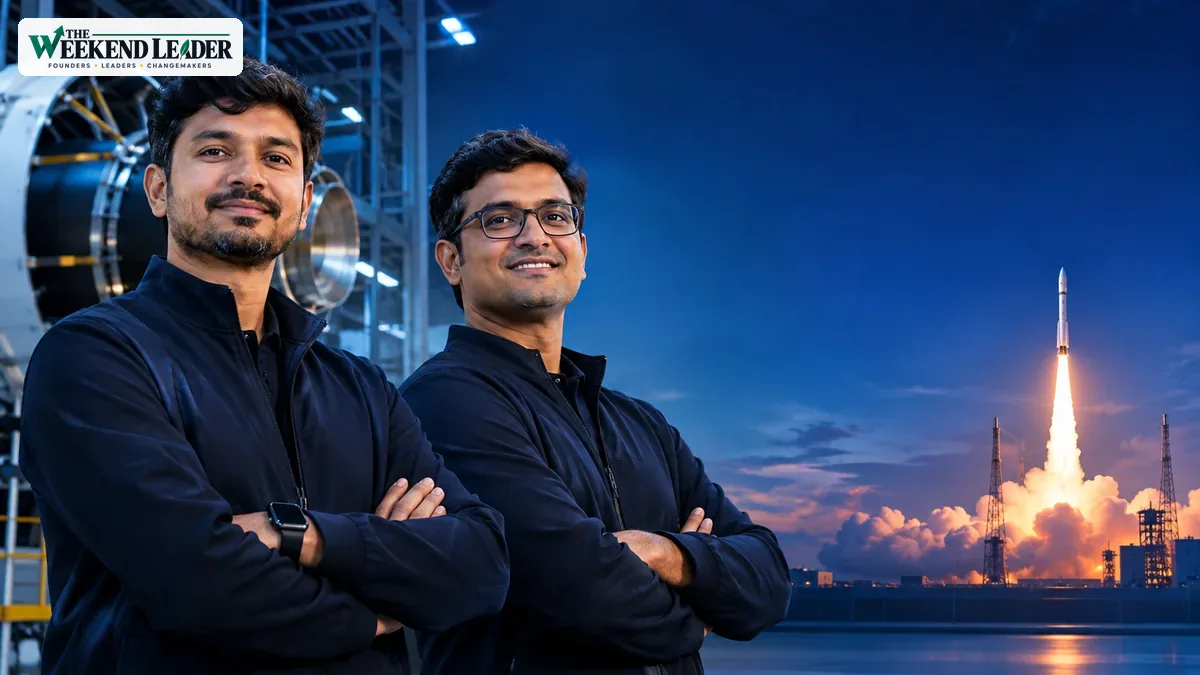
Skyroot Aerospace was founded in 2018 in Hyderabad by Pawan Kumar Chandana and Naga Bharath Daka, two former ISRO engineers. In November 2022 their Vikram-S became the first privately built rocket launched from India, and on 18 July 2026 Vikram-1 reached orbit on its first flight, making India the third country, after the US and China, with a private orbital launch.
Quick facts
| Company | Skyroot Aerospace |
|---|---|
| Founders | Pawan Kumar Chandana (CEO) and Naga Bharath Daka (COO) |
| Founded | 2018, Hyderabad, Telangana |
| Background | Both are IIT alumni who worked at ISRO before starting Skyroot |
| First launch | Vikram-S (Mission Prarambh), 18 November 2022, sub-orbital, about 89.5 km |
| First orbital launch | Vikram-1 (Mission Aagaman), 18 July 2026, Sriharikota |
| Facility | Infinity Campus, Hyderabad, about 200,000 sq ft |
| Valuation | About $1.1 billion after a May 2026 round, India’s first space-tech unicorn |
Leaving ISRO to build a rocket company
For decades, building a launch vehicle in India meant working at ISRO. Pawan Kumar Chandana and Naga Bharath Daka did exactly that. Both studied at the Indian Institutes of Technology and worked as engineers inside the national space agency, on the kind of hardware that most startups never touch.
In 2018 they left to start Skyroot. At the time, India had no clear legal path for a private company to launch a rocket. That changed in 2020, when the government opened the space sector to private players, allowed them to use some ISRO facilities and set up IN-SPACe to authorise and oversee them. Skyroot was the first startup to sign an agreement to use ISRO’s launch and test facilities after the reforms.
The timing matters. The founders started building before the rules existed, which meant designing engines and raising money without knowing exactly when they would be allowed to fly. That is a very different kind of risk from building an app.
Naming the rockets
Skyroot named its launch vehicles Vikram, after Vikram Sarabhai, the founder of India’s space programme. The engines carry names from the same tradition: Kalam for the solid-fuel stages, after APJ Abdul Kalam; Raman for the liquid upper-stage engine, after CV Raman; and Dhawan for the cryogenic engine, after Satish Dhawan.
The cryogenic Dhawan-I, which runs on liquefied natural gas and liquid oxygen, was unveiled in September 2020. Later versions were tested in 2023 and February 2026, and are meant for the heavier Vikram-2.
Vikram-S: the first private rocket launched from India
On 18 November 2022, Vikram-S lifted off from the Satish Dhawan Space Centre in Sriharikota. The mission was called Prarambh, meaning “the beginning”. The 545 kg rocket reached a peak altitude of about 89.5 km and splashed down in the Bay of Bengal roughly five minutes later.
It was a short, sub-orbital flight, but it proved that a private Indian team could design, integrate and fly a rocket from India’s main spaceport. By then Skyroot had raised about $64 million and employed around 200 people, according to Reuters.
Vikram-1 reaches orbit
The real test was orbit. Vikram-1 is a four-stage rocket about 22 metres tall, built with a carbon-composite body and designed to carry about 350 kg to low Earth orbit. Its final stage is a 3D-printed, restartable liquid engine.
Ground tests ran for more than two years: the Kalam-250 second stage in March 2024, the Kalam-100 in April 2025 and the large Kalam-1200 first stage in August 2025. On 27 November 2025, Prime Minister Narendra Modi inaugurated Skyroot’s Infinity Campus in Hyderabad by video conference, and Vikram-1 was unveiled. The campus is designed to build up to one orbital rocket a month.
On Saturday, 18 July 2026, at 12:05 pm IST, Vikram-1 lifted off from Sriharikota on Mission Aagaman. Around 15 minutes later it placed its payloads in an orbit of about 450 km. According to IEEE Spectrum, Skyroot became the first company anywhere to reach orbit on its first attempt.
The payloads included a deployable-structures test for German company DCUBED, a nanosatellite from Grahaa Space, a debris-capture arm from Cosmoserve and Skyroot’s own SCOPE satellite.
Money, valuation and what comes next
| Date | Milestone |
|---|---|
| 2018 | Company founded in Hyderabad |
| Sep 2020 | Dhawan-I cryogenic engine unveiled |
| Nov 2022 | Vikram-S flies; about $64 million raised to date |
| Oct 2023 | $27.5 million round led by Temasek |
| Nov 2025 | Infinity Campus opens; Vikram-1 unveiled |
| May 2026 | About $60 million raised at a $1.1 billion valuation |
| Jul 2026 | Vikram-1 reaches orbit on its first flight |
| 2027 (planned) | First flight of the heavier Vikram-2 |
Skyroot reported revenue of about ₹100 crore for FY26. The next big step is Vikram-2, which is planned to fly in 2027 and lift about 900 kg to low Earth orbit. That would put Skyroot in a market for small satellites where customers care about one thing above all else: getting a dependable ride to space when they need it.
What innovators can learn from Skyroot
- Build before the door opens. Skyroot was founded two years before private launches were allowed. When policy changed, the company already had engines on test stands.
- Use the system you came from. The founders’ ISRO experience shaped their engineering, and ISRO’s facilities made testing possible. Leaving an institution does not mean cutting ties with it.
- Make progress visible. Named engines, public static-fire tests and a sub-orbital flight gave investors milestones to judge long before orbit.
- Deep tech takes years. From founding to orbit took about eight years. That is normal for hardware this hard, and founders need investors who know it.
Read more about India’s builders in our guide to startups from tier-2 cities and our profile of Geetha Manjunath of NIRAMAI, another founder who turned deep research into a company.
Frequently asked questions
Skyroot Aerospace was founded in 2018 in Hyderabad by Pawan Kumar Chandana and Naga Bharath Daka, two former ISRO engineers. Chandana is CEO and Daka is COO.
Vikram-1 launched on 18 July 2026 from the Satish Dhawan Space Centre, Sriharikota, and reached an orbit of about 450 km on its first flight.
Vikram-S was Skyroot’s sub-orbital test rocket. Launched on 18 November 2022 as Mission Prarambh, it was the first privately built rocket launched from India.
The rockets are named after Vikram Sarabhai, founder of India’s space programme. Its engines are named after APJ Abdul Kalam, CV Raman and Satish Dhawan.
Yes. In May 2026 Skyroot raised about $60 million at a valuation of about $1.1 billion, becoming India’s first space-tech unicorn.
Sources
- Skyroot Aerospace, Wikipedia
- Space.com, Jul 2026: Vikram-1, India’s first private orbital rocket, aces debut launch
- IEEE Spectrum, 27 Jul 2026: Skyroot Aerospace’s Vikram-1
- News On AIR, 25 Nov 2025: PM to inaugurate Skyroot’s Infinity Campus
- Al Jazeera / Reuters, 18 Nov 2022: India launches Vikram-S
Facts in this story were checked against the sources above as of 24 November 2026. Figures such as valuations, store counts and job titles change over time; if you spot something out of date, write to us and we will update it.