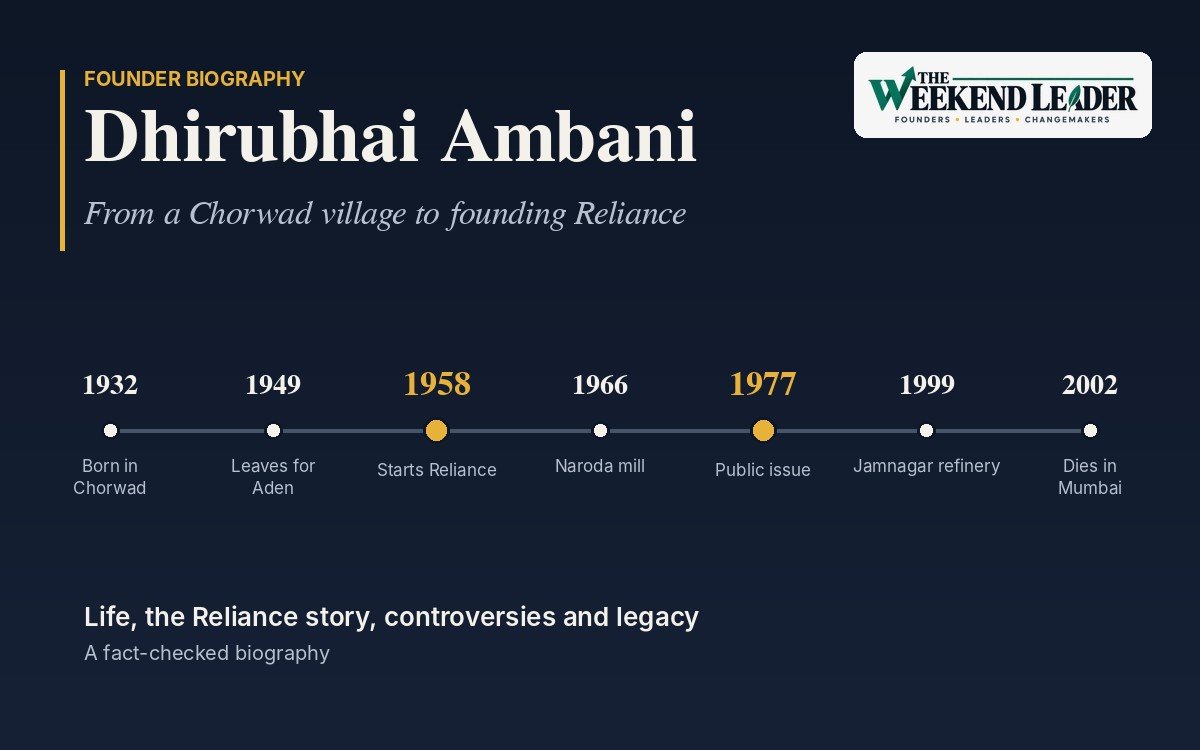
Timeline of Dhirubhai Ambani's life, from his birth in Chorwad in 1932 to founding Reliance in 1958 and his death in 2002.
Dhirubhai Ambani (1932–2002) was the Indian entrepreneur who founded Reliance in 1958 as a small trading firm in Bombay and built it into one of India’s largest business groups. Born Dhirajlal Hirachand Ambani in a Gujarat village, the son of a schoolteacher, he started with no family business or inherited capital. By the time of his death, Reliance had moved from trading yarn to making textiles, polyester, petrochemicals and refined fuels — and had turned lakhs of ordinary Indians into shareholders.
His story is often told as pure inspiration, but it is more interesting than that. It includes real innovation in how an Indian company raised money, a sharp understanding of the licence-era economy, and controversies that are still debated. This biography covers his early life, how Reliance began, his biggest achievements, the criticism he faced and what entrepreneurs can learn from him today.
Who was Dhirubhai Ambani?
Dhirubhai Ambani was the founder of Reliance Industries and one of the most influential first-generation entrepreneurs in Indian history. He is best known for three things: building Reliance from a one-room trading office into a large industrial group, bringing millions of small investors into India’s stock market, and leading the company’s move into large-scale manufacturing of polyester and petrochemicals.
Full name
Dhirajlal Hirachand Ambani
Born
28 December 1932, Chorwad, Junagadh, Gujarat
Died
6 July 2002, Mumbai (aged 69)
Parents
Hirachand Gordhanbhai Ambani (schoolteacher) and Jamnaben Ambani
Spouse
Kokilaben Ambani
Children
Mukesh, Anil, Nina and Dipti
Founded
Reliance Commercial Corporation (1958), later Reliance Industries
Honours
Wharton School Dean’s Medal (1998); Padma Vibhushan (posthumous, 2016)
Dhirubhai Ambani’s early life and family background
Dhirubhai Ambani was born on 28 December 1932 in Chorwad, a coastal village in what was then Junagadh State in British India. His father, Hirachand Gordhanbhai Ambani, was a village schoolteacher from the Modh Bania community, and his mother was Jamnaben Ambani. The family was of modest means.
He studied at Bahadur Khanji school and finished his matriculation around 1949. Like many young men from Gujarat’s coast at the time, he looked overseas for work, where relatives and community networks could help him find a job.
Dhirubhai Ambani’s early career in Aden
In 1949, aged about 17, Dhirubhai went to Aden (now part of Yemen), then a busy British-run port. Biographical sources describe his first job slightly differently: one says he joined A. Besse & Co. as a dispatch clerk and was later put in charge of the company’s oil-filling station at the port; others describe him as working at a Shell petrol station. A. Besse & Co. was the Shell distributor in Aden, so the accounts may describe the same employer. He is commonly reported to have started on about ₹300 a month.
Aden gave him an education no school could: he watched traders from many countries buy and sell commodities, learned how shipping, currency and credit worked, and saw how a port economy rewarded speed and relationships. In 1955 he married Kokilaben, and in 1958 he returned to India to start a business of his own.
How did Dhirubhai Ambani start Reliance?
Dhirubhai Ambani started Reliance in 1958 as Reliance Commercial Corporation, a small trading firm in Bombay, with his second cousin Champaklal Damani. The first office was a 350 sq ft room on Narsinatha Street in Masjid Bunder, with one telephone, one table and three chairs.
The firm exported spices such as ginger, cardamom and pepper to Aden and imported polyester yarn. Yarn trading turned out to be the bigger opportunity: synthetic fabric was in high demand in India, and supplies were tightly controlled. The partnership with Damani ended in 1965, and Dhirubhai decided to move from trading textiles to making them.
Dhirubhai Ambani’s rise in Indian business
The Naroda mill and the Vimal brand
In 1966 he set up a synthetic textile mill at Naroda, near Ahmedabad, under a new company, Reliance Textile Industries. Reliance soon launched the Vimal brand of fabrics, which became one of the best-known textile brands in India. In 1975, according to DA-IICT’s biography, a World Bank technical team described the Naroda mill as “excellent even by developed country standards”.
The 1977 public issue and India’s equity culture
In 1977 Reliance Textile Industries went public, and the issue was oversubscribed seven times. At a time when most Indian companies relied on bank loans and a small circle of investors, Reliance raised money from large numbers of ordinary households, including people in small towns who had never bought shares before. Its shareholder meetings became events: about 30,000 shareholders attended the 1986 annual general meeting at Cross Maidan in Mumbai, DA-IICT records.
This is perhaps his most lasting contribution beyond Reliance itself. He showed that a growing Indian company could fund big projects by inviting the public to share in its growth — an idea that helped build India’s retail investor culture.
From textiles to polyester and petrochemicals
Dhirubhai pursued “backward integration” — making the raw materials his business depended on. In the early 1980s Reliance set up a polyester filament yarn plant at Patalganga in Maharashtra with technical collaboration from DuPont, followed by a polyester staple fibre plant in 1986. The company changed its name from Reliance Textile Industries to Reliance Industries in 1985.
Reliance then moved further back up the chain into petrochemicals, with a complex at Hazira in Gujarat commissioned in 1991–92. Its refinery at Jamnagar, announced in 1997 at a cost of about $6 billion, was commissioned in 1999 — in the final years of his life.
Year
Milestone
1932
Born in Chorwad, Gujarat
1949
Moves to Aden for work
1958
Returns to India; starts Reliance Commercial Corporation
1966
Sets up the Naroda textile mill
1977
Reliance Textile Industries goes public
Early 1980s
Polyester filament yarn plant at Patalganga
1985
Company renamed Reliance Industries
1986
Suffers a stroke; sons take on day-to-day management
1991–92
Hazira petrochemical complex commissioned
1999
Jamnagar refinery commissioned
2002
Dies in Mumbai on 6 July
Dhirubhai Ambani’s leadership style and business philosophy
Accounts of his career point to a few consistent traits. These are our observations from documented decisions, not quotations.
Think big, build fast: Reliance repeatedly built plants at a scale larger than Indian competitors, aiming for cost advantages.
Control the value chain: he moved from trading to fabric, then to yarn, fibre, petrochemicals and refining, so Reliance depended less on suppliers.
Treat capital as a strategy: public issues and a broad shareholder base gave Reliance access to money that banks alone would not provide.
Understand the system: in the licence-era economy, government permissions and import policy decided who could grow. He read that system closely — a strength his supporters admired and his critics questioned.
Many motivational quotes circulate online under his name. We have not used them here because we could not trace them to a reliable original source.
Major achievements of Dhirubhai Ambani
Built a major Indian business group from scratch, starting with a one-room office in 1958.
Helped create a retail equity culture through Reliance’s 1977 public issue and its large base of small shareholders.
Industrialised at scale in textiles, polyester and petrochemicals, culminating in the Jamnagar refinery commissioned in 1999.
Global recognition: in 1998 he became the first Indian to receive the Dean’s Medal from the Wharton School of the University of Pennsylvania. India awarded him the Padma Vibhushan posthumously in 2016, and a postage stamp was issued in his honour in 2002.
Challenges and controversies
Dhirubhai Ambani’s career was also marked by criticism and controversy, which any balanced biography should include. Many of these questions were never finally settled.
Closeness to government: critics argued that Reliance benefited from favourable policy decisions during the licence era. Rival industrialist Nusli Wadia of Bombay Dyeing, who fought Reliance in a bitter polyester rivalry in the 1980s, later blamed his company’s losses on what he called Ambani’s “manipulation of policies”. Reliance and its supporters rejected such claims.
The “bear cartel” episode: in the early 1980s a group of brokers short-sold Reliance shares; buyers supporting the stock took delivery, and the Bombay Stock Exchange closed for three business days.
Foreign investments: in 1982–83, large investments in Reliance came through companies registered in the Isle of Man. The matter was raised in Parliament; the Reserve Bank of India found no illegal act.
A banned biography: Hamish McDonald’s unauthorised biography, The Polyester Prince (1998), was not published in India; an updated version, Ambani and Sons, appeared in 2010.
Context matters: India’s economy before 1991 was tightly regulated, and many large companies of the period faced questions about their relationships with the state. These controversies sit alongside his achievements; they do not cancel them.
Dhirubhai Ambani’s family and business legacy
After a stroke in February 1986 paralysed his right hand, Dhirubhai handed day-to-day control of Reliance to his sons, Mukesh and Anil Ambani. He remained chairman and a guiding presence until his death on 6 July 2002 at Breach Candy Hospital in Mumbai, following a second stroke.
The brothers ran Reliance together until a public dispute led to a family settlement in 2005. Mukesh Ambani kept Reliance Industries and its petroleum, petrochemicals and textiles businesses; Anil Ambani took the telecom, power and financial services businesses, which became the Reliance Anil Dhirubhai Ambani Group. Reliance’s later ventures — such as its expansion into retail and digital services — belong to the next generation’s record, not to Dhirubhai’s.
Lessons entrepreneurs can learn from Dhirubhai Ambani
Spot the gap in your market. He saw that Indian demand for synthetic fabric outstripped supply.
Learn by doing. Aden taught him trade and finance long before he ran a company.
Build relationships. Customers, traders and shareholders were central to his growth.
Take calculated risks. Large plants were bets on future demand, backed by planning.
Understand capital. His use of public markets was as important as his factories.
Dhirubhai Ambani (1932–2002) was an Indian entrepreneur who founded Reliance in 1958 and built it into one of India’s largest business groups, spanning textiles, polyester, petrochemicals and refining. He is also known for bringing millions of small investors into the stock market.
2. When and where was Dhirubhai Ambani born?
Dhirubhai Ambani was born on 28 December 1932 in Chorwad, a village in Junagadh district, Gujarat. His father, Hirachand Gordhanbhai Ambani, was a schoolteacher.
3. What was Dhirubhai Ambani famous for?
He is famous for founding Reliance Industries, building it from a small trading firm into a major industrial group, and popularising share ownership among ordinary Indians through Reliance’s 1977 public issue.
4. How did Dhirubhai Ambani start Reliance Industries?
He started Reliance Commercial Corporation in Bombay in 1958 with his cousin Champaklal Damani, trading spices and polyester yarn. In 1966 he set up a textile mill at Naroda; that company went public in 1977 and was renamed Reliance Industries in 1985.
5. What was Dhirubhai Ambani’s first business?
His first business was Reliance Commercial Corporation, a trading firm started in 1958 that exported spices to Aden and imported polyester yarn into India.
6. What was the Vimal brand?
Vimal was Reliance’s textile brand, launched after the company opened its Naroda mill in 1966. It became one of India’s best-known fabric brands and helped establish Reliance as a manufacturer.
7. When did Dhirubhai Ambani die?
Dhirubhai Ambani died on 6 July 2002 in Mumbai, aged 69, after a second stroke. He had suffered his first stroke in 1986.
8. Who took over Reliance after Dhirubhai Ambani?
His sons Mukesh and Anil Ambani jointly managed Reliance after his death. In a 2005 settlement, Mukesh kept Reliance Industries, while Anil took the telecom, power and financial services businesses.
9. What can entrepreneurs learn from his business journey?
Entrepreneurs can learn to spot unmet demand, scale step by step, understand how to raise capital, and build relationships with customers and investors — while also noting, from the controversies, why transparency and good governance matter.
10. Why is Dhirubhai Ambani remembered in Indian business history?
He is remembered as one of India’s most successful first-generation entrepreneurs, who built a major industrial group without inherited wealth and changed how Indian companies raise money from the public.
Conclusion
Dhirubhai Ambani’s journey — from a schoolteacher’s son in Chorwad to a clerk in Aden to the founder of Reliance Industries — remains one of the defining stories of Indian enterprise. His real legacy lies less in the size of the company than in what he showed was possible: that an outsider could build at global scale, and that ordinary Indians could share in that growth as shareholders.
His career is best understood in its historical context, including the regulated economy and the controversies of his time. For today’s founders, the takeaway is to dream big and plan carefully — and to build the kind of trust that lasts beyond any single generation.