
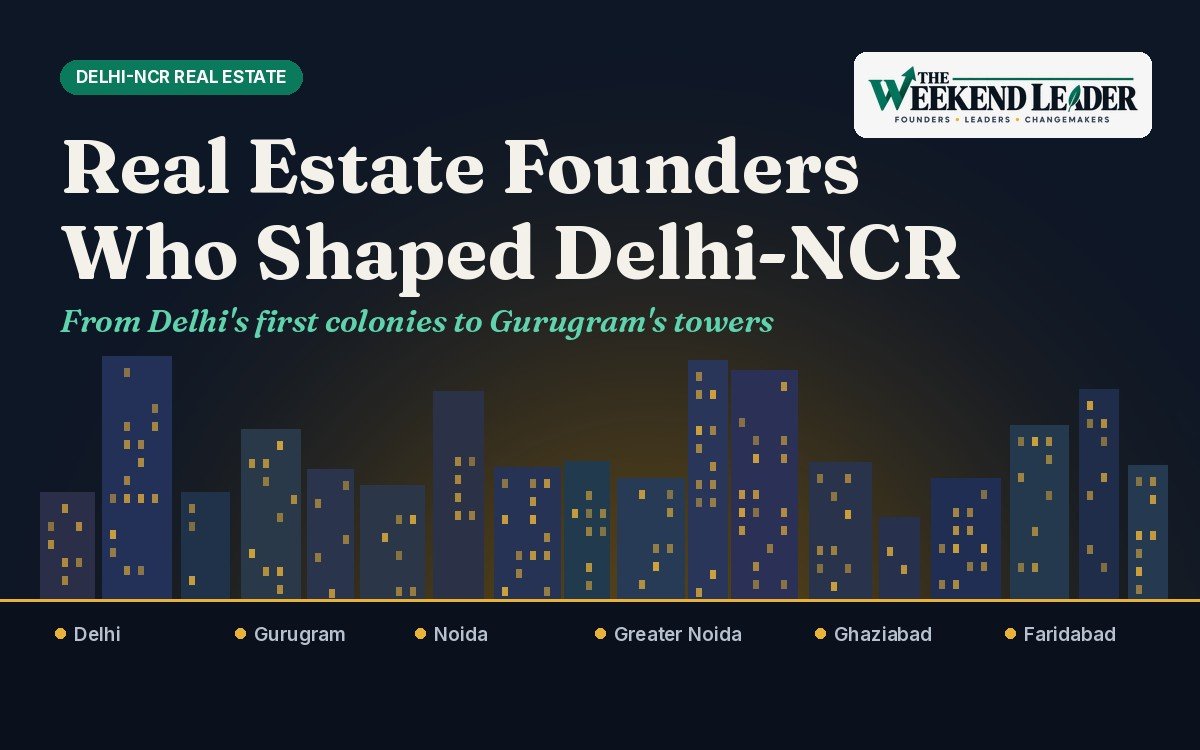
The real estate founders who shaped Delhi-NCR include Chaudhary Raghvendra Singh and K.P. Singh of DLF, Ramesh Chandra of Unitech, Rohtas Goel of Omaxe, Getamber Anand of ATS, Basant Bansal of M3M, Pradeep Kumar Aggarwal of Signature Global and Kabul Chawla of BPTP, alongside national and global groups such as Godrej Properties and Emaar. Their companies built many of the colonies, office districts, townships and housing societies that now define Delhi, Gurugram, Noida, Greater Noida, Ghaziabad and Faridabad.
But no developer built the region alone. Delhi-NCR grew because of planning laws, new industrial authorities, highways, the Delhi Metro, multinational employers and millions of homebuyers. This article explains how the market evolved, profiles ten founders and their companies, and looks honestly at the challenges — from stalled projects to RERA — that shaped the industry along the way.
Key terms
- Real estate founder: the person (or people) who started a property company.
- Developer: the company that buys or partners on land, gets approvals, builds and sells projects. A founder may later hand the company to successors.
- Mixed-use development: a project that combines homes, offices, shops and leisure in one place.
How Delhi-NCR became a major real estate hub
Delhi’s early colonies. After Independence, private developers built many of Delhi’s residential colonies. DLF, founded in 1946, built 21 colonies, including South Extension, Greater Kailash and Hauz Khas. The Delhi Development Act of 1957 then gave the government control over land development in Delhi, which pushed private developers to look beyond the city’s borders.
Gurugram’s rise. Land in Haryana, then cheap and largely agricultural, became the new frontier. Through the 1970s and 1980s, developers assembled land around Gurgaon (renamed Gurugram in 2016). Multinational offices followed, then DLF Cyber City (established 2003) and the Delhi Metro, which reached HUDA City Centre (now Millennium City Centre Gurugram) on 21 June 2010. A Rapid Metro link to Cyber City opened in 2013.
Noida and Greater Noida. Noida was created on 17 April 1976 under the UP Industrial Area Development Act, as part of a plan to spread growth away from Delhi. Unlike Gurugram’s largely private model, Noida and Greater Noida grew under planned development authorities that allotted land to developers. Expressways, the Noida Metro’s Aqua Line and an IT and electronics manufacturing base drew both companies and homebuyers.
Changing demand. Buyers moved from plotted colonies to gated high-rise societies, then to integrated townships, and more recently to premium and branded residences. Government policy, public infrastructure and India’s broader economic growth mattered as much as any single company.
Real estate founders who shaped Delhi-NCR: at a glance
| Company | Founder(s) | Founded | Main NCR markets | Verified contribution |
|---|---|---|---|---|
| DLF | Chaudhary Raghvendra Singh; expanded by K.P. Singh | 1946 | Delhi, Gurugram | 21 Delhi colonies; DLF City and Cyber City in Gurugram |
| Unitech | Ramesh Chandra and four partners | 1972 | Gurugram, Noida, Greater Noida, Ghaziabad | Large residential and commercial portfolio |
| Emaar India | Emaar Properties (founded by Mohamed Alabbar), with MGF Developments | 2005 (JV) | Gurugram, Delhi | 2010 Commonwealth Games Village; Gurugram housing and offices |
| Omaxe | Rohtas Goel | 1983 (incorporated 1989) | Noida, Greater Noida, Delhi | NRI City township; Omaxe Chowk in Chandni Chowk |
| ATS Infrastructure | Getamber Anand | 1998 | Noida | Group housing; founder led CREDAI nationally |
| BPTP | Kabul Chawla | 2003 | Faridabad, Gurugram, Noida | Parklands township; LEED Platinum Capital City |
| Mahagun Group | Pawan Kumar Jain, Dhiraj Jain, Amit Jain | 1995 | Ghaziabad, Noida | Residential societies in Ghaziabad and Noida |
| M3M India | Basant Bansal | 2010 | Gurugram | Luxury residential and commercial projects |
| Signature Global | Pradeep Kumar Aggarwal and family promoters | 2014 | Gurugram, Sohna | Affordable and mid-income housing at scale |
| Godrej Properties | Adi Godrej (Godrej Group) | 1990 | Gurugram, Noida, Greater Noida | National brand entering NCR housing |
Profiles: the founders and their companies
1. Chaudhary Raghvendra Singh and K.P. Singh — DLF
Chaudhary Raghvendra Singh founded DLF on 4 July 1946. Its first project, Krishna Nagar in East Delhi, was completed in 1949, and the company went on to build 21 Delhi colonies including South Extension, Greater Kailash and Hauz Khas. When the 1957 Delhi Development Act ended private development within Delhi, DLF turned to land in Haryana.
Kushal Pal Singh — a former Indian Army officer married to Raghvendra Singh’s daughter, Indira — became managing director after DLF merged with American Universal Electric in 1979. He revived the company and led the patient, plot-by-plot purchase of land from farmers in Gurgaon. DLF City began in the mid-1970s, and DLF Cyber City (2003) became one of the largest office districts in the region. DLF’s IPO in July 2007, of about US$2 billion, was then India’s largest. K.P. Singh received the Padma Bhushan in 2010 and retired from executive roles in 2020; his son Rajiv Singh is chairman.
Key takeaway: DLF is the clearest example of a founder building a city’s first private colonies and a successor building a new city’s commercial core. It is widely regarded as a pioneer of Gurugram’s development.
2. Ramesh Chandra — Unitech
Unitech began in 1972 as United Technical Consultants, a soil-investigation firm started by Ramesh Chandra and four partners. It moved into civil engineering contracts in 1974 and later into real estate, building homes and offices across Gurugram, Noida, Greater Noida and Ghaziabad.
Unitech’s later history is a cautionary one. Its telecom venture was caught up in the 2G spectrum case, in March 2017 Sanjay and Ajay Chandra were arrested over alleged fraud against homebuyers in a Gurugram project, and in December 2019 the Supreme Court asked the central government to take over the company’s management, citing about 30,000 homebuyers. A government-appointed board took charge in January 2020.
Key takeaway: Unitech helped build NCR’s skyline in the 2000s, and its collapse became one of the strongest arguments for stricter oversight of developers and buyers’ money.
3. Emaar India — Mohamed Alabbar’s Emaar and MGF
Emaar Properties was founded in Dubai in 1997 by Mohamed Alabbar and is known for Burj Khalifa and The Dubai Mall. Its Indian business began in 2005 as Emaar MGF, a joint venture with MGF Developments, in which Emaar was the larger partner. The partners separated in 2016, and the business continues as Emaar India under professional management.
In NCR, the joint venture built the 2010 Commonwealth Games Village in Delhi, and Emaar India has developed housing and commercial projects across Gurugram, including Palm Drive, Palm Gardens and Emerald Hills.
Key takeaway: Emaar brought global capital and a Gulf developer’s brand into NCR. Its founder is global; its NCR story is one of partnership and professional leadership rather than a local founder.
4. Rohtas Goel — Omaxe
Rohtas Goel started a construction and contracting business in 1983 and incorporated Omaxe Builders in 1989. Omaxe listed on the NSE and BSE in 2007, and by 2017 reported having delivered about 100 million sq ft, including construction contracts.
In NCR, Omaxe launched NRI City, an 85-acre integrated township in Greater Noida, in 2003; The Forest in Noida in 2004; and Omaxe Connaught Place in Greater Noida in 2015. In 2019 it announced Omaxe Chowk, a public-private redevelopment project in Delhi’s Chandni Chowk. Omaxe also expanded into many smaller cities across North India.
Key takeaway: Goel’s path — from contractor to developer — shows how construction know-how became a foundation for township development in Greater Noida and beyond.
5. Getamber Anand — ATS Infrastructure
Getamber Anand, a first-generation entrepreneur and engineering graduate of Punjab Engineering College, founded ATS in Noida in 1998. The company focused on group housing societies in Noida and the wider NCR. By 2015, ATS reported about 33.5 million sq ft delivered or under development.
Anand also played an industry role: he became national president of CREDAI, the developers’ association, on 24 March 2015, at a time when the sector was preparing for new regulation.
Key takeaway: ATS represents the Noida model — a homegrown developer building planned, amenity-rich societies on authority-allotted land — and its founder’s industry leadership.
6. Kabul Chawla — BPTP
Kabul Chawla, a first-generation entrepreneur from Karnal, founded BPTP (Business Park Town Planners) in 2003. Its signature bet was Faridabad: the Parklands township in Greater Faridabad spans about 2,000 acres. BPTP reports more than 24,500 units delivered, and its Capital City in Noida earned LEED v4.1 O+M Platinum certification in 2025.
BPTP also faced buyer complaints over delayed possession at some projects in the 2010s, as Outlook reported. Read our full profile of Kabul Chawla and BPTP.
Key takeaway: BPTP’s story shows how developers helped put Faridabad on the real estate map — and how delivery, not sales, ultimately builds reputation.
7. Pawan Kumar Jain — Mahagun Group
Mahagun Group’s flagship, Mahagun India Pvt. Ltd., was incorporated in 1995, with Pawan Kumar Jain described as the group’s founder alongside Dhiraj Jain and Amit Jain. The group concentrated on Ghaziabad and Noida — markets that grew as Delhi’s eastern suburbs expanded.
Its projects include Mahagun Mansion, Mahagun Mosaic and Mahagunpuram in Ghaziabad, and Mahagun Moderne and Mahagun Mezzaria in Noida, along with projects in Meerut and Moradabad.
Key takeaway: Mahagun reflects the growth of Ghaziabad and Noida as family-oriented residential markets for people working across Delhi.
8. Basant Bansal — M3M India
Basant Bansal, a first-generation entrepreneur, founded M3M India in 2010 and serves as its chairman and managing director, with Roop Bansal and Pankaj Bansal also among its promoters. M3M focused on Gurugram’s luxury residential and commercial segments, with projects such as M3M Golf Estate and Trump Towers Delhi NCR.
Key takeaway: M3M represents the post-2010 wave of Gurugram developers who leaned into premium and branded real estate as the city’s corporate wealth grew.
9. Pradeep Kumar Aggarwal — Signature Global
Signature Global began operations in 2014 with Solera, a project on a 6.13-acre plot in Gurugram. Its promoters include Pradeep Kumar Aggarwal (chairman), Lalit Kumar Aggarwal, Ravi Aggarwal and Devender Aggarwal. The company built its business on affordable housing, moved into mid-income housing in 2017 and premium housing in 2024.
By 31 March 2023, it had sold 27,965 residential and commercial units, all in Delhi-NCR. It listed on the stock exchanges in 2023 after a ₹730 crore IPO, and reports 19.2 million sq ft delivered as of Q1 FY27 (April–June 2026).
Key takeaway: Signature Global showed that affordable housing in Gurugram and Sohna could be a large, listed business, not just a policy obligation.
10. Adi Godrej — Godrej Properties
Godrej Properties was established in 1990 by Adi Godrej as the real estate arm of the Godrej Group, and listed in 2010. Pirojsha Godrej, a fourth-generation family member, has led the company since 2012. The company is a national developer rather than an NCR original, but it has expanded significantly in Gurugram, Noida and Greater Noida in recent years.
Key takeaway: Godrej Properties’ growth in NCR reflects a newer trend — national, listed brands winning buyer trust in a market once dominated by regional developers.
How these founders transformed Gurugram, Noida and Greater Noida
- Gurugram: a largely private-led model. DLF assembled land and built the office core; Unitech and Emaar added housing and offices; M3M pushed luxury; Signature Global scaled affordable housing; Godrej brought a national brand.
- Noida and Greater Noida: an authority-led model. Developers such as ATS, Omaxe and Mahagun built on land allotted by development authorities, creating dense group-housing societies, townships such as NRI City, and commercial projects.
- Ghaziabad and Faridabad: residential growth on Delhi’s edges, with Mahagun in Ghaziabad and BPTP’s Parklands in Faridabad.
Across all markets, offices brought jobs, jobs created housing demand, and retail and mixed-use projects followed — but public infrastructure such as the metro and expressways often decided which locations succeeded.
Common business strategies behind their success
- Early land acquisition: buying where growth was heading, as DLF did in Gurgaon and BPTP in Faridabad.
- Diversification: mixing residential, commercial and retail to balance cycles.
- Brand and trust: listed companies such as DLF, Godrej Properties and Signature Global use disclosure and track record to win buyers.
- Infrastructure-led growth: projects near metro lines and expressways tend to sell faster.
- Partnerships and capital: joint ventures (Emaar MGF), public listings and public-private projects (Omaxe Chowk).
- Following demand: from colonies to towers to townships to premium and affordable segments.
These are industry patterns, not a single formula every founder followed.
Challenges and lessons from Delhi-NCR’s real estate industry
- Delayed and stalled projects: thousands of NCR buyers waited years for homes in the 2010s. The Supreme Court’s intervention at Unitech in 2019 is one well-documented example.
- Regulation and RERA: the Real Estate (Regulation and Development) Act, 2016 created state regulators, project registration and escrow rules to protect buyers’ money.
- Building compliance: on 28 August 2022, Supertech’s twin towers in Noida were demolished after the Supreme Court found they violated building norms and the UP Apartment Act.
- Fair dealing: in 2011 the Competition Commission of India fined DLF ₹630 crore over unfair terms, after complaints from buyers in Gurugram projects.
- Market cycles and finance: developers that borrowed heavily in boom years struggled when sales slowed.
- Sustainability: green certification, such as BPTP Capital City’s LEED Platinum rating, is becoming a mark of quality.
The future of Delhi-NCR real estate
The following is an outlook, not a forecast of certain outcomes. Watch for: new infrastructure such as the Noida International Airport at Jewar and expanding expressways, which may open new micro-markets; continued demand for premium and branded housing in Gurugram; more integrated townships; green-certified buildings; growth in office and data-centre real estate; and technology for property management and buyer transparency.
Frequently asked questions
Who are the most influential real estate founders in Delhi-NCR?
Widely cited names include Chaudhary Raghvendra Singh and K.P. Singh (DLF), Ramesh Chandra (Unitech), Rohtas Goel (Omaxe), Getamber Anand (ATS), Kabul Chawla (BPTP), Basant Bansal (M3M) and Pradeep Kumar Aggarwal (Signature Global). Influence depends on the market and era you look at; there is no official ranking.
Who founded DLF?
DLF was founded on 4 July 1946 by Chaudhary Raghvendra Singh, who built many of Delhi’s early colonies. His son-in-law, K.P. Singh, later led DLF’s expansion into Gurgaon, and K.P. Singh’s son Rajiv Singh is now chairman.
Who is considered a pioneer of Gurugram’s real estate development?
K.P. Singh of DLF is widely regarded as a pioneer of Gurugram’s development. From the 1970s he led DLF’s land assembly in Gurgaon, which became DLF City and later DLF Cyber City, one of the region’s largest office districts.
Which real estate developers have shaped the Gurugram property market?
DLF, Unitech, Emaar India, M3M India, Signature Global, BPTP and Godrej Properties are among the developers that have shaped Gurugram, across offices, luxury housing, affordable housing and mixed-use projects.
Who are some notable founders of real estate companies in Noida?
Getamber Anand founded Noida-based ATS Infrastructure in 1998; Rohtas Goel’s Omaxe built NRI City in Greater Noida and The Forest in Noida; and the Jain family’s Mahagun Group built societies in Noida and Ghaziabad.
What is the difference between a real estate founder and a developer?
A founder is the person who starts a property company; a developer is the company that acquires land, obtains approvals, builds and sells projects. Many developers outlive their founders and are run by successors or professional managers.
How did real estate entrepreneurs contribute to Delhi-NCR’s urban growth?
They assembled land, built housing, offices and retail, and invested ahead of demand. Their work combined with public planning, the Delhi Metro, expressways and employers to turn farmland in Gurugram, Noida and Faridabad into major urban centres.
What factors should buyers consider when evaluating a real estate developer?
Check the project’s RERA registration, the developer’s record of on-time delivery, construction quality in completed projects, approvals and land titles, financial health, and reviews from existing residents. Visit finished projects before buying.
Conclusion
The real estate founders who shaped Delhi-NCR came from very different starting points: a pre-Independence colony builder, an army officer, soil engineers, contractors, family businesses and first-generation entrepreneurs. Together with global and national groups, they built the colonies, offices and societies millions of people now call home.
Yet the region’s growth was shared work. Planning authorities, the Delhi Metro, highways, employers, regulators and homebuyers all played their part — and the industry’s setbacks show that trust is earned through delivery, not promises. As Delhi-NCR enters its next phase, that lesson matters more than ever. Read more founder stories on The Weekend Leader, including our profile of first-generation entrepreneurs in India.
Sources
- DLF (company); Kushal Pal Singh; Cyber City Gurgaon
- Unitech Group; Business Standard on Unitech’s board
- Emaar Properties; Emaar India
- Omaxe — company journey
- ATS Infrastructure; PR Newswire — Getamber Anand, CREDAI president (2015)
- BPTP; Outlook on BPTP
- Housing.com — Mahagun builder overview
- GRI — Basant Bansal, M3M India
- Signature Global — about us; DSIJ — Signature Global IPO analysis (2023)
- Godrej Properties; Outlook Business — Godrej Properties in Gurugram
- Noida; Millennium City Centre Gurugram metro station
- Business Today — Supertech twin towers demolished (2022)
Written by The Weekend Leader editorial team. Last updated: October 2026. Company figures are as reported by the companies or the sources above and may have changed.